 SAMPLED
How Does a Vinyl Record Actually Store Sound?
From Edison's tinfoil cylinder to the stylus on your turntable: a plain-English, photo-by-photo guide to how music gets carved into a groove and played back.
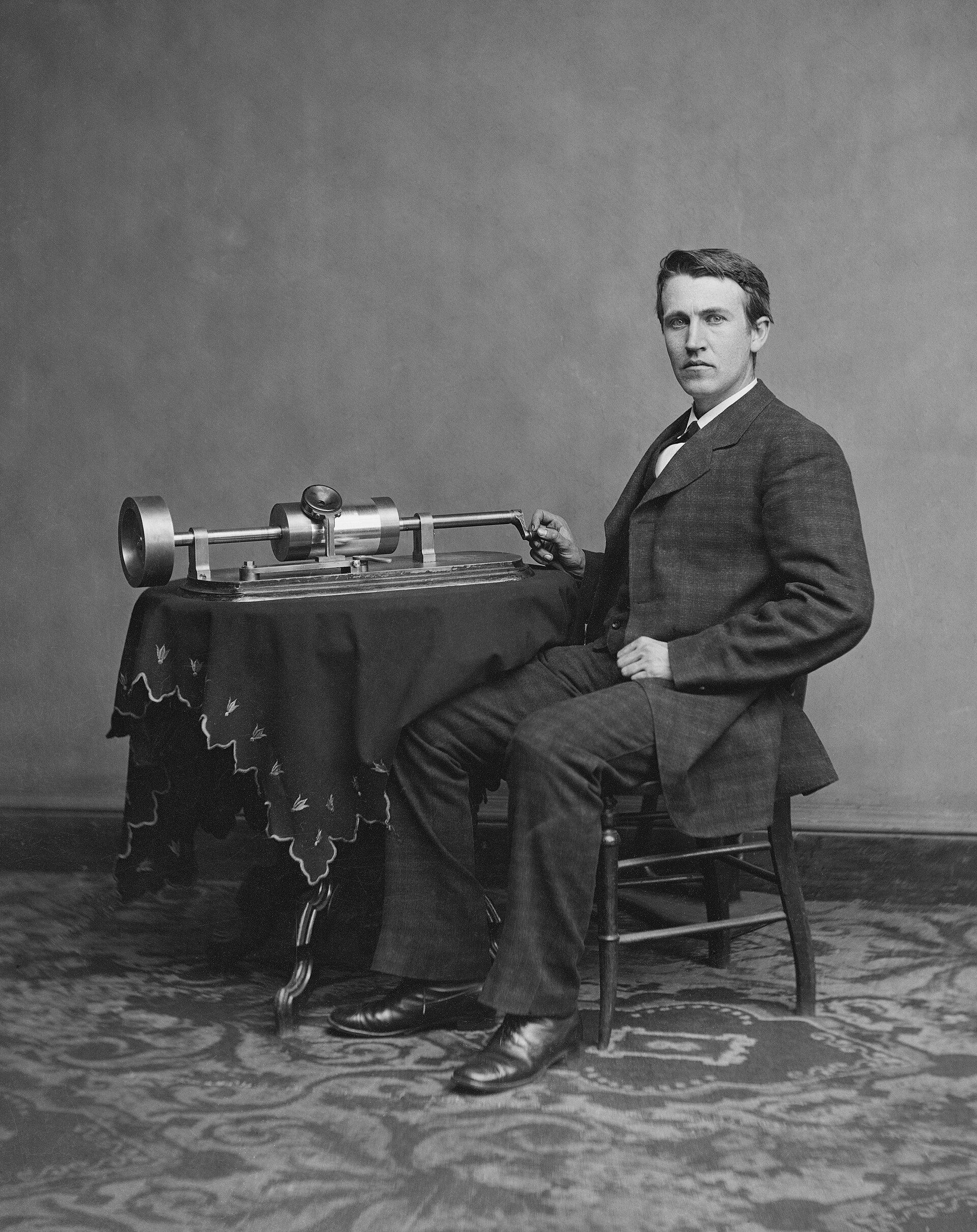
A vinyl record is one of the few music formats you can understand just by looking at it. There is no code, no file, no laser. The sound is a physical shape: a single spiral groove whose wiggles match the vibrations of the music. This guide walks through how that groove is made and how your turntable turns it back into sound, using public-domain photos from the Library of Congress and free-license studio photos.
Who invented recorded sound?
Thomas Edison built the first working phonograph in 1877. The idea was simple: sound waves shake a thin diaphragm, a needle attached to the diaphragm shakes with it, and that needle scratches a matching pattern into a soft surface as it turns. Run a needle back over the same pattern and the process works in reverse. The diaphragm shakes again, and you hear the sound.
Edison's first machine recorded onto tinfoil wrapped around a cylinder. Later cylinders used wax, which held more detail and lasted longer. The cover photo shows Edison with one of his phonographs, taken by Levin C. Handy and now held by the Library of Congress.
Why are records flat discs instead of cylinders?
Emile Berliner, a German-born inventor working in Washington, D.C., patented the gramophone in 1887. He made two changes that shaped every record since:
- A flat disc instead of a cylinder. Discs are easier to store, ship and stack.
- A side-to-side groove instead of an up-and-down one. Edison's needle moved up and down (called "hill and dale"). Berliner's moved left and right, which tracked more reliably.
The big win was mass production. A cylinder was hard to copy, but a disc could be stamped from a metal master, like a coin. That is still how records are made today.
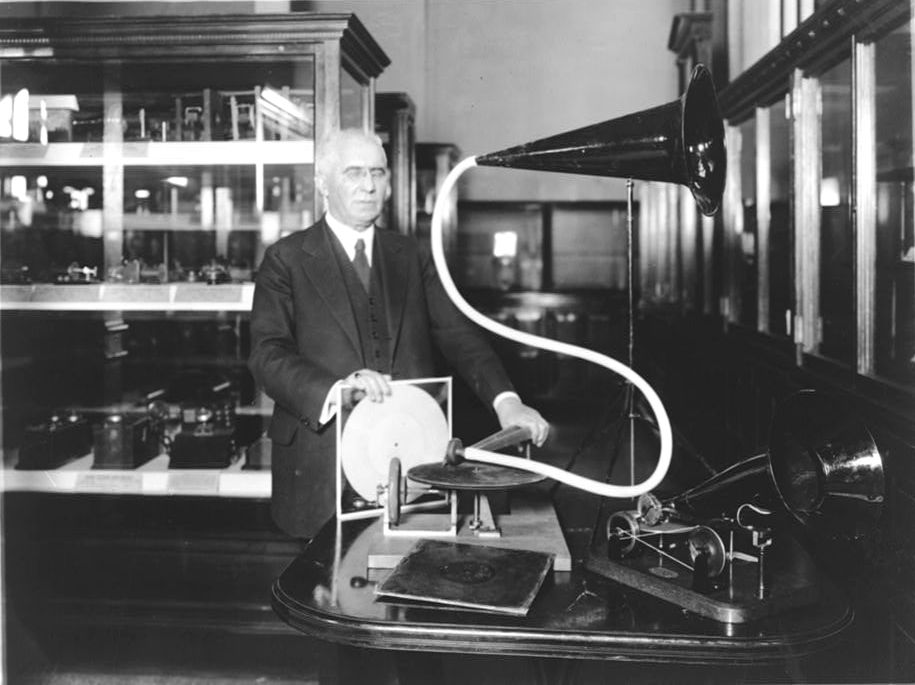 Photo: National Photo Company Collection, Library of Congress, via Wikimedia Commons (opens in a new tab) (public domain)
Berliner's patent drawings show how mechanical it all was. There's a hand crank, a turntable, a horn to make the sound louder, and no electricity at all.
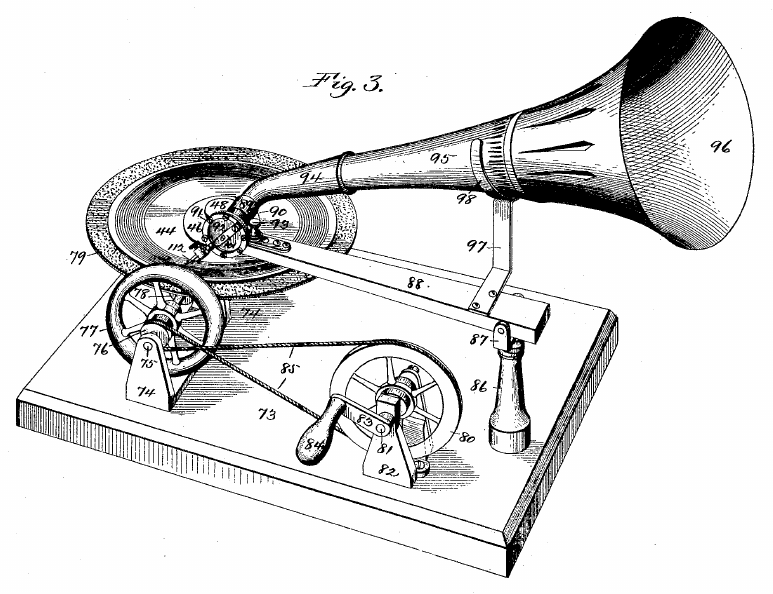 Image: Emile Berliner, U.S. patent 534,543 (1895), via Wikimedia Commons (opens in a new tab) (public domain)
What is actually in the groove?
Picture the waveform you see in your music software. Now picture that wave drawn as the wiggle of a groove. Here's how to read it:
- How fast the groove wiggles is the pitch. Fast wiggles are high notes, slow wiggles are low notes.
- How wide the groove wiggles is the volume. Big swings are loud, small swings are quiet.
- One continuous spiral runs from the outside edge toward the label. Each side of a record is really one very long groove.
How does stereo fit in one groove? Stereo records arrived in 1958. The groove is V-shaped, and each wall carries one channel: the inner wall holds the left channel and the outer wall holds the right. Because each wall sits at 45 degrees, the system is called "45/45." The needle reads both walls at once, so one groove plays two speakers.
What do 33, 45 and 78 mean? They're how many times the record spins per minute. Early shellac discs spun at about 78. Columbia introduced the 12-inch 33⅓ RPM long-playing record (LP) in 1948, and RCA Victor introduced the 7-inch 45 in 1949. Spinning slower with a finer groove fits more music on each side.
How is a record cut in the studio?
Records start on a cutting lathe. A mastering engineer plays the finished music into the lathe, which drives a heated, very sharp cutting stylus into a blank disc (usually an aluminum disc coated with lacquer) and carves the spiral groove in real time.
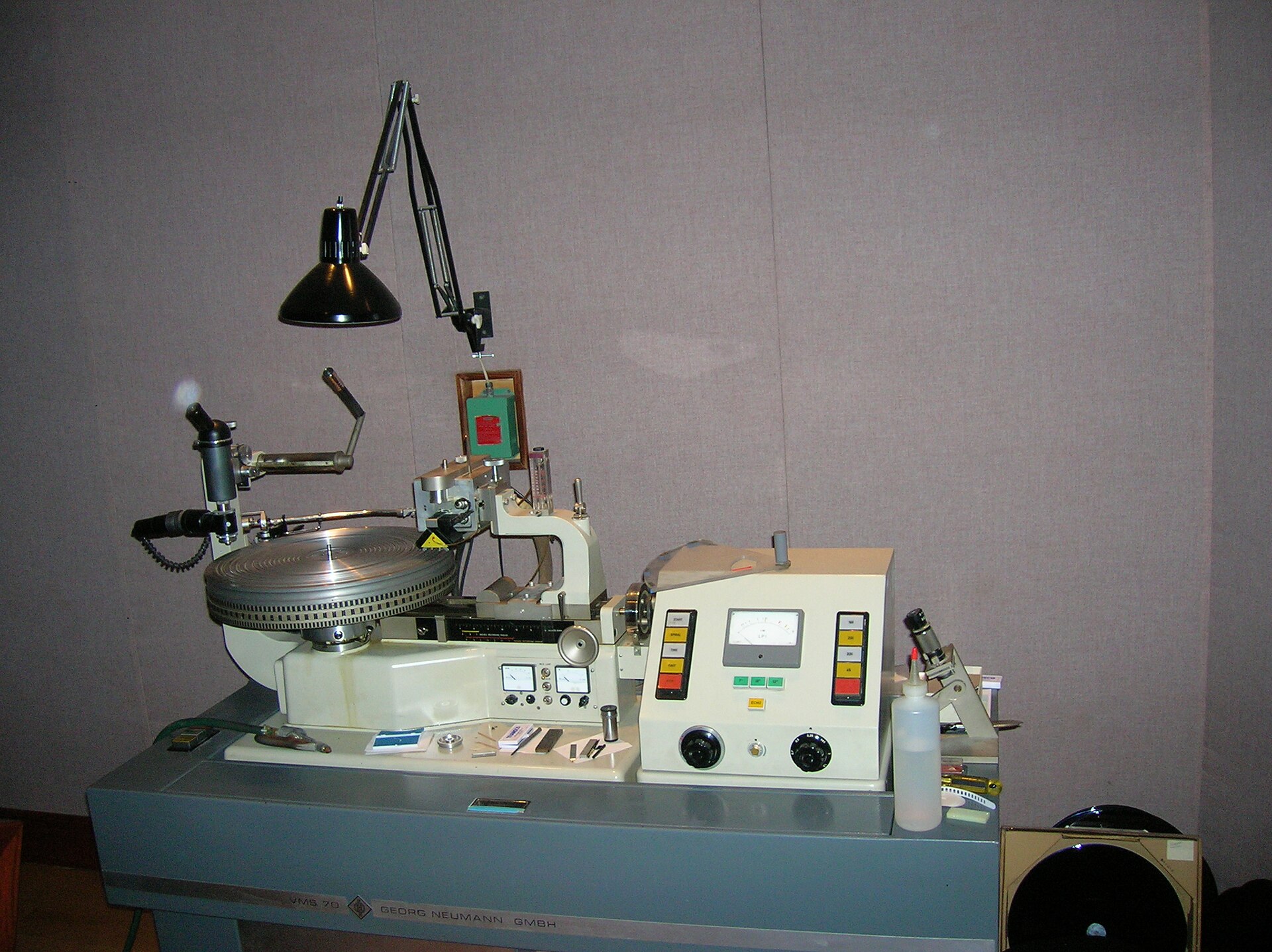 Photo: VACANT FEVER via Wikimedia Commons (opens in a new tab) (CC BY-SA 2.0)
This is why vinyl mastering is its own skill. Physics limits what a groove can hold:
- Too much bass makes the groove swing so wide it can run into the next one, or throw the needle out.
- Harsh, loud high end can be too sharp for a playback needle to follow, which causes distortion.
- Bass that differs a lot between left and right makes the groove move up and down too much. That's why engineers usually keep the low end centered in mono.
- Longer sides mean quieter records, because the grooves have to be packed closer together.
Engineers also use the RIAA curve, an industry standard adopted in the 1950s. When cutting, they turn the bass down and the treble up. When you play the record, a "phono preamp" does the opposite. Turning the bass down saves groove space, and turning the treble back down at home hides surface noise.
How are thousands of copies made from one cut?
The soft lacquer disc is too fragile to press from, so it's copied in metal through electroplating:
- The lacquer gets a thin metal coat, then a thicker layer of nickel is plated on top.
- The "father" is that nickel layer, peeled off. It's a negative: ridges where the grooves were.
- The "mother" is plated from the father. It's a positive again and can be played to check for faults.
- The stampers are negatives plated from the mother. They're mounted in the press.
The press squeezes a hot puck of vinyl (PVC) between two stampers, one for each side, with the paper labels in the middle. Steam heats it, cold water cools it, and a finished record comes out in well under a minute.
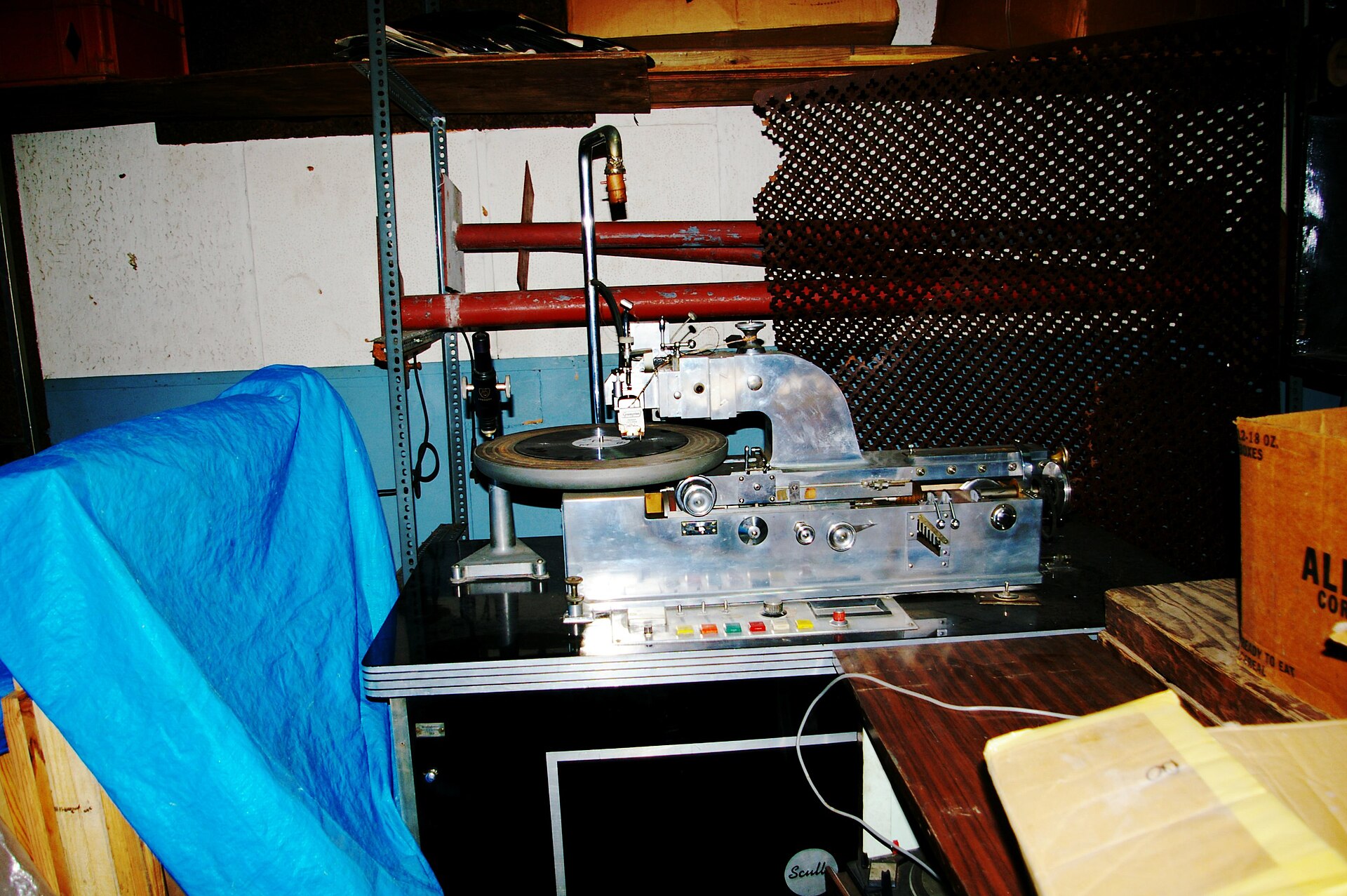 Photo: Christina Xu via Wikimedia Commons (opens in a new tab) (CC BY-SA 2.0)
How does a turntable turn the groove back into sound?
Playback runs the cutting process in reverse:
- The stylus is a tiny diamond tip that rides in the groove and gets pushed side to side (and, for stereo, at angles) by the wiggles.
- The cartridge holds the stylus and turns that movement into a very small electrical signal. In the common "moving magnet" type, a tiny magnet on the end of the stylus arm moves near coils of wire, which creates a voltage.
- The phono preamp boosts that weak signal and applies the reverse RIAA curve, so the bass and treble come back to normal.
- The amplifier and speakers do the rest.
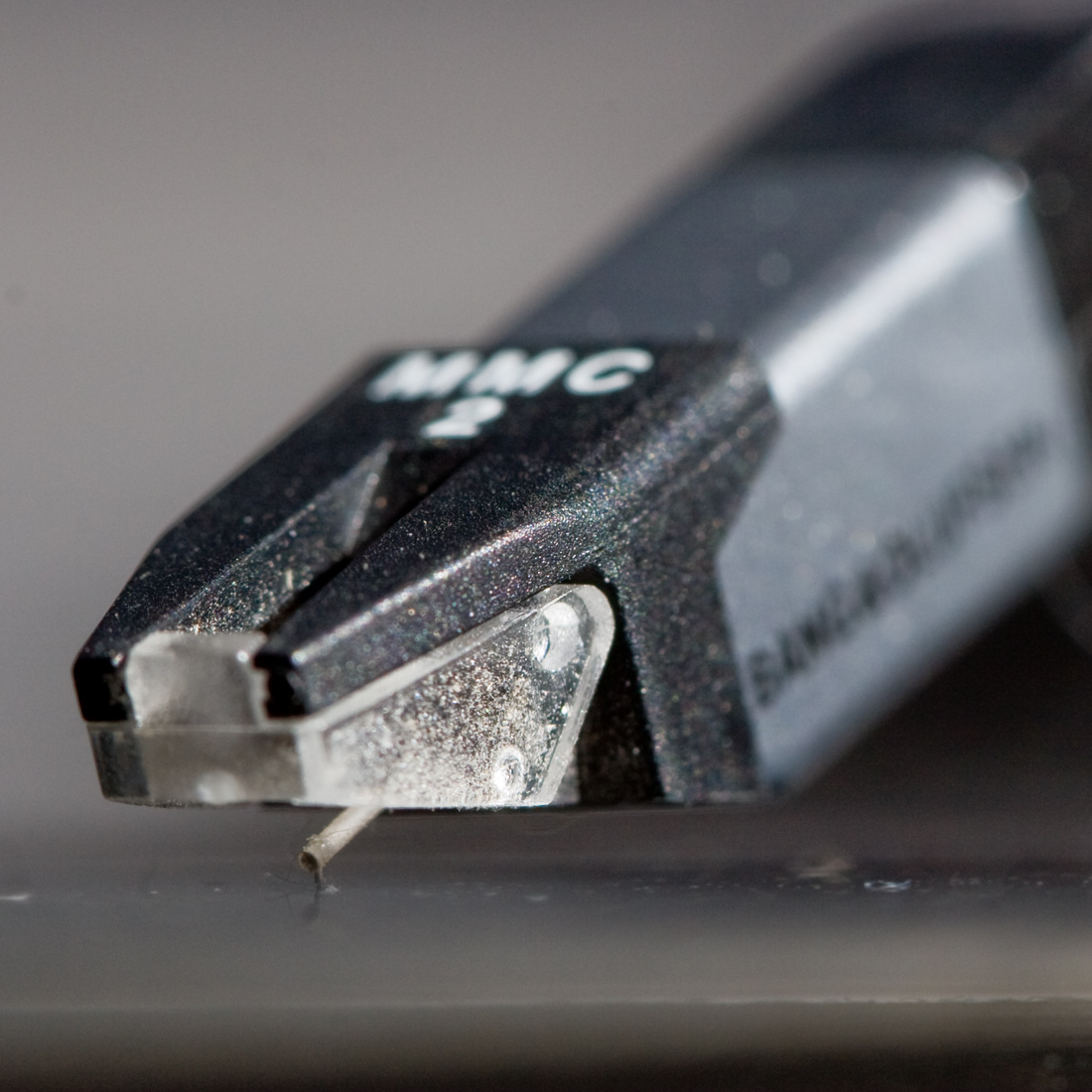 Photo: Heje via Wikimedia Commons (opens in a new tab) (CC BY 3.0)
What does this mean for you as a listener or producer?
If you play records:
- Plug in through a phono input or preamp. Without the reverse RIAA curve, records sound thin and tinny. Many turntables now have one built in, with a "phono/line" switch.
- Replace a worn stylus. A chipped or worn tip doesn't just sound worse; it can damage the groove.
- Keep records clean and stored upright. Dust gets ground into the groove walls, and warps throw the needle around.
If you're putting your music on vinyl:
- Ask for a vinyl-specific master. A loud master made for streaming often has to be redone for vinyl anyway.
- Keep bass and sub-bass centered. It cuts more cleanly and keeps the needle in the groove.
- Watch side length. Roughly 18–22 minutes per side on a 12-inch LP at 33⅓ is a comfortable range; past that, levels usually come down.
- Approve your test pressings. Listen all the way through before the full run.
If you're working on the master itself, our guides on mastering and EQ cover the basics. And if all this has you wanting to dig through crates, start with where to find records.
The short answer
A record stores sound as a shape. The music is carved as one spiral groove whose wiggles copy the sound wave. It's copied into metal stampers, pressed into vinyl, and played back by a diamond stylus that feels those wiggles and turns them back into electricity. Every step is something you could watch with your own eyes, which is a big part of why records still feel special almost 150 years after Edison first played one back.