 SAMPLED
The 1982 acid house record that predates acid house is back in print
Light in the Attic's remastered reissue of Charanjit Singh's "Synthesizing: Ten Ragas to a Disco Beat" is finally in listeners' hands — and on August 11 it got the national radio treatment it never got in 1982.
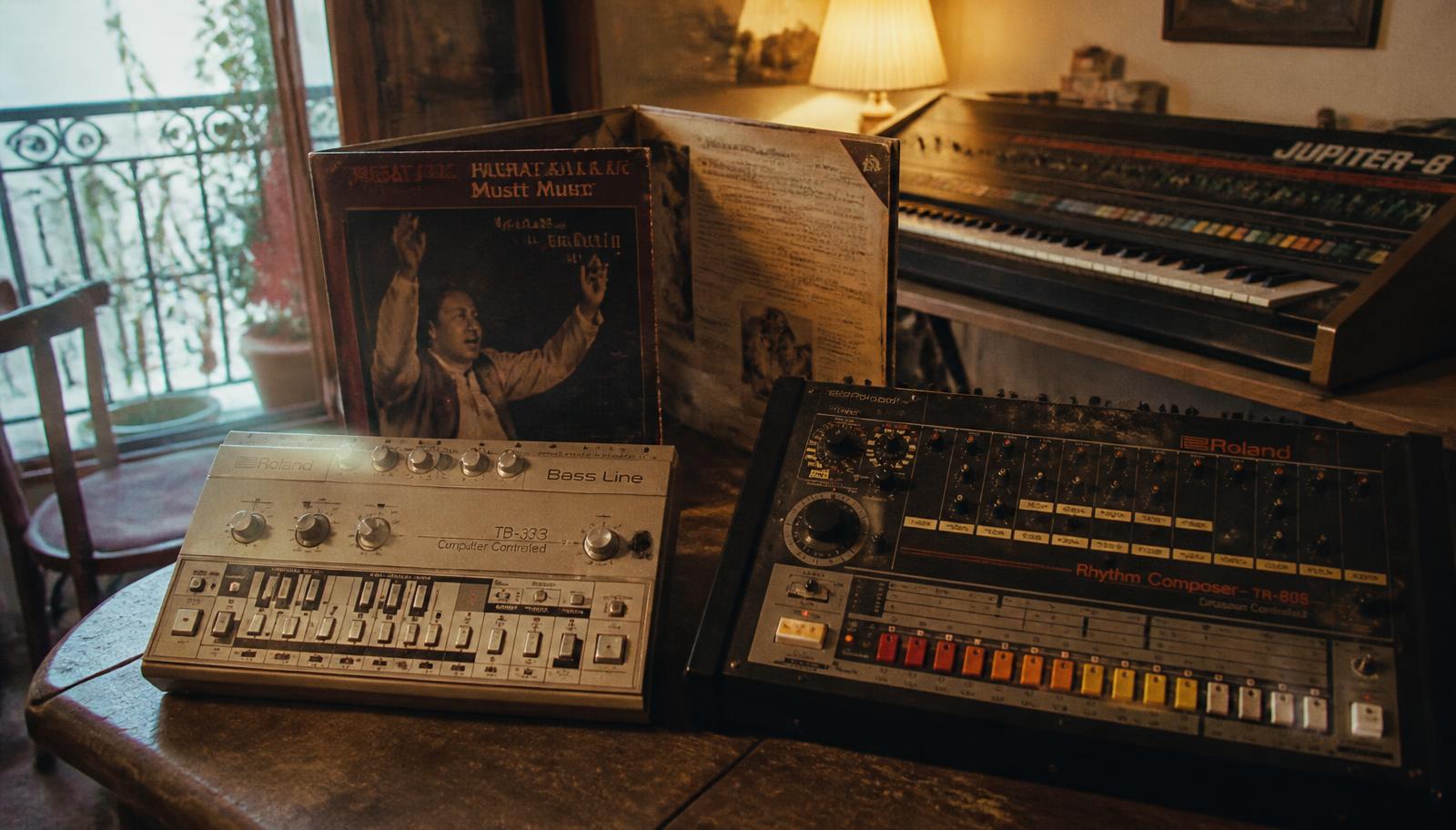
On August 11, 2026, NPR's All Things Considered ran a segment (opens in a new tab) on a record that sounds like an '80s club track and was actually made in a Mumbai flat before the club it sounds like existed. That record is Synthesizing: Ten Ragas to a Disco Beat, cut in 1982 by Bollywood session musician Charanjit Singh, and it is now back in print via Light in the Attic (opens in a new tab) as a deluxe 2xLP and CD.
If you care about where machine music actually comes from, this is the most important reissue of the year.
What Singh actually did
Singh spent two decades as a working session player in the Hindi film industry — the kind of musician whose hands are on hundreds of records and whose name is on none of them. On a trip to Singapore in the early '80s he encountered Roland's then-new boxes: the TB-303 Bass Line, the TR-808 Rhythm Composer, and the Jupiter-8.
Everyone else who bought a 303 in 1982 was trying to make it sound like a bass guitar, failing, and returning it. Singh did something else. He programmed Hindustani ragas into it — the scale degrees, the ornamentation, the slides — and ran them over a straight four-on-the-floor 808 pattern. Ten ragas, ten tracks, one absurd idea executed with total conviction.
The result is acid house. Squelching, resonant, filter-swept acid house, made roughly five years before Phuture's "Acid Tracks" gave Chicago the genre's founding document. Singh wasn't inventing acid house on purpose; he was applying a classical vocabulary to a new machine and arriving at the same place from the other direction.
Why it took forty years
The album sold essentially nothing. It sat in obscurity until crate diggers surfaced it in the late 2000s, at which point a 2010 Bombay Connection reissue turned it into a cult object. Both the original and that reissue then went out of print, and copies started fetching collector prices — the standard fate of a record everyone suddenly wants and nobody can press.
Singh died in 2015. He got to see a sliver of the recognition — European festival bookings, a late-career second life — but not this.
What's in the reissue
Light in the Attic's edition (LITA 226) is a proper archival job rather than a repress:
- Newly remastered audio by Johanz Westerman
- Expanded gatefold and booklet with unseen photographs from the Singh family archive
- New liner notes from Discostan's Arshia Fatima Haq and Jeremy Loudenback, plus contributions from Singh's grandchildren — singer-songwriter Rachel Singh and composer Joshua Singh
- Formats: 2LP on pearlescent color wax ($40), 2LP black ($38), CD ($18), with bundle configurations that shipped through early August
The family involvement matters here. A lot of "lost genius" reissues are done around the artist's estate rather than with it. This one reads like the opposite.
The gear lesson underneath it
There is a tidy takeaway for anyone who owns a synthesizer and worries they are using it wrong.
The 303 was a commercial failure because it did not do the job it was sold to do. Its entire cultural legacy comes from people who ignored the manual — Chicago producers who bought them used for cheap, and, earlier and alone, a session musician in Mumbai who heard a filter sweep and thought of a raga. The machine did not have a genre in it. The people did.
That's also why the record still lands. It isn't a novelty of "Indian classical meets disco." The ragas are real ragas, played with real fluency, and the sequencing is tight because Singh had spent twenty years being paid to be accurate. It's a virtuoso record that happens to have been made on toys nobody respected yet.
Where to start
Put on "Raga Bhairav" first — it's the clearest statement of the thesis, 303 acid lines resolving into scale shapes that no Chicago producer would have reached for. Then "Raga Megh Malhar" for the drama. Then go back and listen to any 1987–89 acid record and try to hear it the same way.
The reissue is available directly from Light in the Attic (opens in a new tab).