 SAMPLED
Which Underground Hip-Hop Albums Dropped This November That Every Beatmaker Needs to Hear?
Five November 2026 releases worth studying for production: Aesop Rock and Blockhead, Armand Hammer, Mike Ladd, Deleteeglitch, and AHNAMUSICA—with verified credits and direct buying links.
A release calendar tells you what came out. A good listening session tells you what you can take back to your own beats.
November 2026 has offered several different answers to the same production question: how do you build a world around a rapper without crowding the rapper out? Blockhead approaches it through an album-length partnership with Aesop Rock. Armand Hammer bring a dozen production names into one record. Mike Ladd does most of the building himself, then brings Preservation into the finishing process. Further from that familiar circle, Deleteeglitch and AHNAMUSICA offer useful studies in atmosphere and restraint.
Here are five released albums, not a list of preorders. Dates and credits come from the artists’ and labels’ own pages, checked November 27, 2026. Sonic descriptions are attributed where they come from published reporting; the listening exercises are our suggestions, not claims about undocumented studio techniques or identified sample sources.
The quick listening route
- Aesop Rock x Blockhead — Trouble Mountain: November 13. Start with “Trouble Trouble” and “No Interviews” for an arrangement-focused session.
- Armand Hammer — Snakes & Ladders: November 11. Compare “Deadbolts,” “Send for Me,” and “if we must die” across three credited producers.
- Mike Ladd — Nonechosen: November 6. Try “Twenty Five,” “Time Has,” and “Face Eaters” for contrasting textures within a largely self-produced record.
- Deleteeglitch — water wings: November 11. Use “dryer sheets,” “mark sanchez,” and “sunken ship” to explore how different producers support one emotional setting.
- AHNAMUSICA — Wesing: November 3. Move between “River,” “We Love Vinyl,” and the vocal track “We Sing” to study instrumental and vocal space.
All five have direct Bandcamp digital purchase pages. Physical formats vary; the buying notes below distinguish actual listings from formats we could not verify.
1. Aesop Rock x Blockhead — Trouble Mountain
Released: November 13, 2026, through Rhymesayers Entertainment. Production: Blockhead.
The organizing idea is a fictional mountain resort, inspired by the Poconos getaway advertising Aesop and Blockhead encountered growing up in New York. It is a useful reminder that an album concept can be more than matching artwork: it can give the beats a shared destination. The official album page (opens in a new tab) describes the production as lean, kinetic, and evolving.
For concrete sonic entry points, Phillip Mlynar’s Bandcamp Daily roundup points to the brass and heavy drums of “Trouble Trouble,” then the rattling snares and developing, spy-film-like strings of “No Interviews.” Those are reported descriptions—not evidence of a particular compressor, drum machine, or original sample. 1 (opens in a new tab)
The beatmaker takeaway: a repeating musical idea does not have to mean a static arrangement. Listen to “No Interviews” once for the vocal, then again for what changes underneath it. Mark where a layer enters, disappears, or shifts emphasis. Ask whether the change announces itself or quietly alters the pressure of the verse.
Try it: take one of your own eight-bar loops and arrange a longer verse using only subtraction, one added texture, and a change in drum emphasis. You are studying the principle of movement, not recreating Blockhead’s music.
Where to buy: Bandcamp digital (opens in a new tab) lists a $10 minimum. Rhymesayers lists a standard 2LP edition (opens in a new tab) at $35 and a deluxe 4LP edition (opens in a new tab) at $75, including the instrumentals. The latter is especially relevant for producers who want to compare backing arrangements with the vocal album. Both listings include digital downloads; check current stock and shipping at checkout. 2 (opens in a new tab)
2. Armand Hammer — Snakes & Ladders
Released: November 11, 2026, through Backwoodz Studioz. Artists: billy woods and ELUCID.
The official Bandcamp credits (opens in a new tab) name Preservation, clipping., Animoss, Kenny Segal, Sebb Bash, Mekala Session, Child Actor, Saint Abdullah & Eomac, Theravada, Jeff Markey, Messiah Musik, and Steel Tipped Dove. This is a particularly useful record to approach as a comparison session rather than a hunt for one signature preset.
Three track pages give you an accurate starting map: “Deadbolts” is produced by clipping. (opens in a new tab), “Send for Me” by Kenny Segal (opens in a new tab), and “if we must die” by Sebb Bash (opens in a new tab). Do not assume that an album-level contributor produced a specific track unless the track credit says so.
The engineering credits matter too. Steel Tipped Dove engineered the album. Willie Green at The Greenhouse Recording Co. is credited with mixing and mastering, with “Nightswim” specifically credited as mixed by Kenny Segal. That exception is worth noting: a record’s finishing process can have more than one route while still belonging to one project.
The beatmaker takeaway: listen for the relationship between beat density and vocal intelligibility. On those three opening selections, compare how much musical activity sits beneath a line, how the low end supports it, and where silence or a simpler passage gives the words room. Treat these as questions to answer with your ears, not assumptions about how the sessions were built.
Try it: make two versions of a beat with the same vocal or scratch verse. In one, keep the melodic layer running. In the other, remove it for selected phrases. Match playback loudness before deciding which version has more impact.
Where to buy: the artist’s Bandcamp page (opens in a new tab) lists digital at $10 minimum and black vinyl at $39.98. CD and cassette were marked sold out when checked. Physical stock can change quickly; buy from the official page rather than assuming a resale premium is necessary.
For background, our Armand Hammer guide and Backwoodz Studioz label guide map the wider circle.
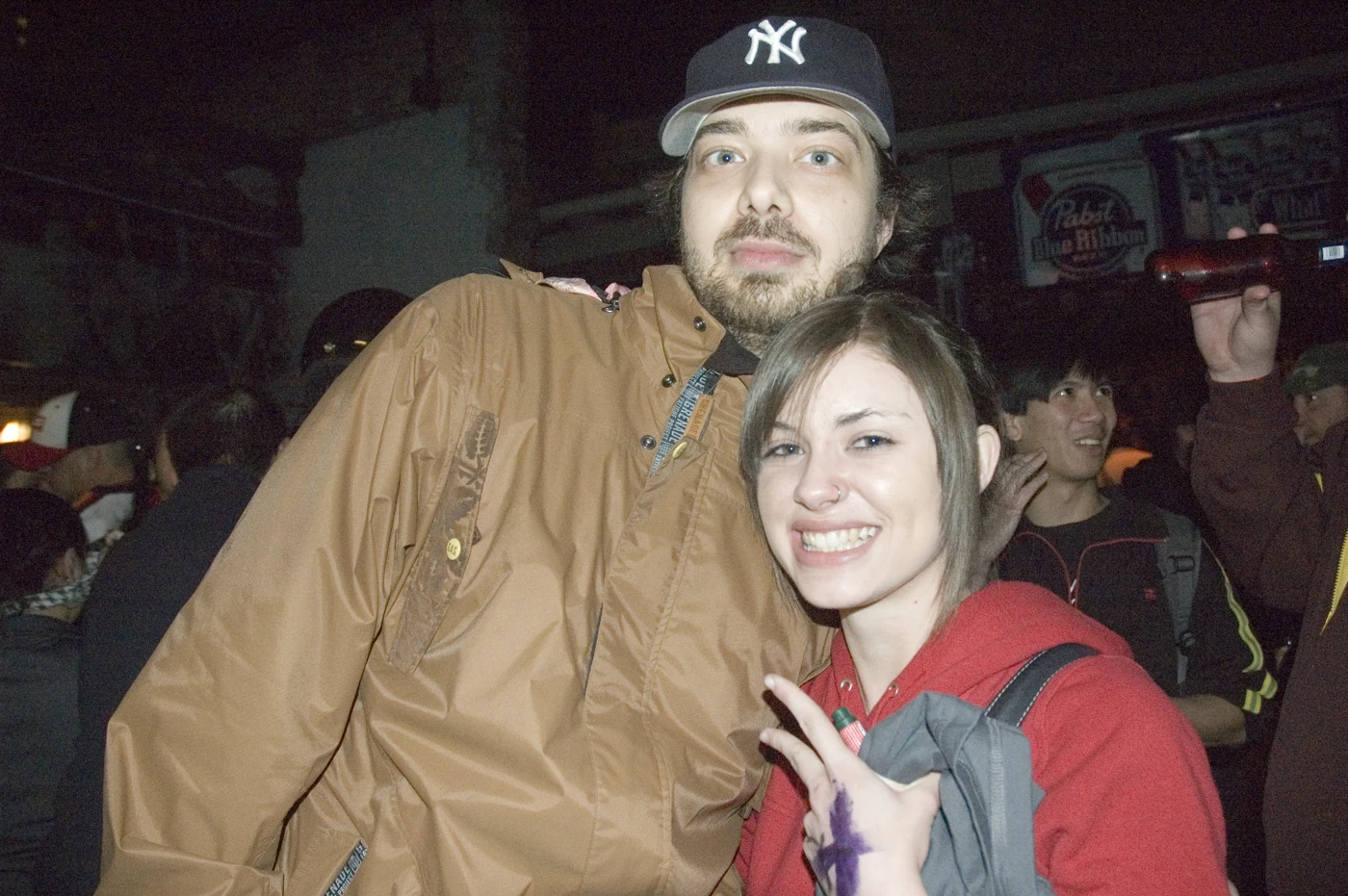
Archive photo: That Other Paper, via Wikimedia Commons (opens in a new tab), CC BY-SA 2.0 (opens in a new tab). Resized. Aesop Rock with writer Chelsey Delaney in 2007; this is not a November 2026 release photograph.
3. Mike Ladd — Nonechosen
Released: November 6, 2026, through Backwoodz Studioz. Production: largely Mike Ladd, with Preservation credited as co-producer.
The label’s account is unusually useful for producers: Ladd brought the record roughly 95 percent of the way there with his own production before passing it to Preservation for further refinements. That is the label’s description of the collaboration, not a measured allocation of every sound or royalty share. The official album page (opens in a new tab) credits mixing to Scotty Hard and The Neve, and mastering to Alexandre Debauchy.
The release announcement describes contrasting textures across the songs: “Twenty Five” as space-blues, brass and pitched soul on “Time Has,” and overdriven energy on the track it calls “Face Eater.” The current Bandcamp track list calls that last song “Face Eaters.” We use the current listing here so you can find it easily. 3 (opens in a new tab)
The beatmaker takeaway: an album can change its surface without abandoning its author. Compare those three tracks for the role of the vocal and the amount of roughness in the supporting sounds. Then ask what remains consistent when the texture changes.
Try it: finish a beat as far as you can before asking a trusted collaborator for three specific changes. “What competes with the vocal?”, “Where does the energy sag?”, and “What should disappear?” are more useful requests than “make this professional.” The lesson is the value of another set of ears, not that every unfinished beat needs more processing.
Where to buy: Mike Ladd’s Bandcamp (opens in a new tab) lists digital at $10 minimum, vinyl at $34.98, CD at $15.98, and cassette at $16.98. Physical purchases include digital. Our full Nonechosen article goes deeper into Ladd’s return and collaborators.
4. Deleteeglitch — water wings
Released: November 11, 2026. Recording and mixing: Deleteeglitch, with sonic optimization and additional mixing credited to GENG PTP.
The artist’s release note (opens in a new tab) frames this 19-track album around shame, self-preservation, and the difficulty of being honest. The credits show an expanded production circle, including Scoops, shemar, Fuzzytincan, clayhead, and several others.
For a focused three-song session, the credits assign “dryer sheets” to Scoops, “mark sanchez” to Fuzzytincan, and “sunken ship” to shemar. Bandcamp Daily describes their respective backdrops through heavy, grainy piano-and-drum texture, fragmented soul-loop warmth, and submerged, echoing percussion. That reporting gives you useful listening prompts without pretending to identify the sample records or effects chains. 1 (opens in a new tab)
The beatmaker takeaway: texture can connect an album made by different hands. Listen to those tracks for how percussion feels near or far from the vocal. Separate the question of drum loudness from the question of drum presence: a sound’s tail and the space around it can affect your impression too.
Try it: build two treatments of your own percussion loop—one dry, one with a controlled ambience send. Keep the vocal unchanged and level-match the examples. Choose the version that fits the story rather than the version that sounds bigger in isolation.
Where to buy: direct Bandcamp digital (opens in a new tab), $11.11 minimum. We did not verify a physical edition on that page.
5. AHNAMUSICA — Wesing
Released: November 3, 2026, through Stereofox Records. Producer: AHNAMUSICA.
Not every useful reference album needs to be abrasive. The Japanese producer’s 14-track debut LP (opens in a new tab) combines instrumental hip-hop with guest vocal performances. The official description emphasizes warm samples, dusty drums, mellow grooves, and a wish to offer calm and connection.
Bandcamp Daily identifies “River,” “We Love Vinyl,” and “Plum Tree” as instrumental entry points, then highlights MJ the Sensei’s presence on “We Sing” and moor no ie on “Omajinai.” Its descriptions emphasize small melodic fragments and carefully shaped drums rather than sheer layer count. 1 (opens in a new tab)
The beatmaker takeaway: study what changes when a beat becomes a song. Compare an instrumental selection with “We Sing”: how much attention does the melody ask for, and how much room remains for a voice? This is a listening comparison, not a claim that the tracks share the same session or backing beat.
Try it: make a 60-second instrumental with one main melodic idea, then record a scratch vocal over it. Remove anything that keeps pulling your ear away from the words. You may discover that the strongest move is leaving a sound out.
Where to buy: Bandcamp digital (opens in a new tab), €12 minimum. We did not verify a vinyl listing on the artist’s page.
Turn the roundup into one useful studio session
Do not turn five albums into five unfinished imitation beats. Pick one question and give it half an hour:
- Choose two reference songs that address a problem you actually have: a static loop, an overcrowded verse, or drums that feel detached.
- Listen once without working. Let the music be music before it becomes homework.
- Listen again with a notepad. Write down a few changes in arrangement or texture. Describe what you hear; do not invent a plugin name to explain it.
- Apply one idea to your own material. Use your own recording, an authorized sample, or a sound with a suitable license.
- Compare at a similar listening level. A louder version can seem more impressive without solving the musical problem.
- Save the experiment and stop. A small, finished lesson is worth more than another folder of abandoned loops.
Buying an album does not give you permission to sample it in a commercial release. If a reference sends you digging, start with our guide to sampling music legally. For practical tempo and tonal checks, use how to find the key and BPM of a song or sample.
A note on dates, prices, and production claims
This is a curated snapshot of releases available by November 27, not a complete November chart or a ranking of every independent rap album. A November editorial roundup can include earlier music: for example, Kid Acne’s LET IT FLOW appeared in Bandcamp’s November column, but its artist page dates it to October 2, so it is not included as a November album here.
Prices above are the listed minimum digital prices or physical item prices at the check, before shipping and applicable tax. Availability can change. We have not presented unverified sample IDs, drum-machine models, compression settings, or proprietary mix techniques as facts. The records themselves—and the people credited with making them—are the starting point.