 SAMPLED
What Headphones Do Studio Engineers Use? Why It Is Still the Sony MDR-7506
Born from the 1985 MDR-V6 and sold through Sony's pro division since 1991, the MDR-7506 is in more studios, news trucks, and film sets than any other headphone. Here is why it stuck.
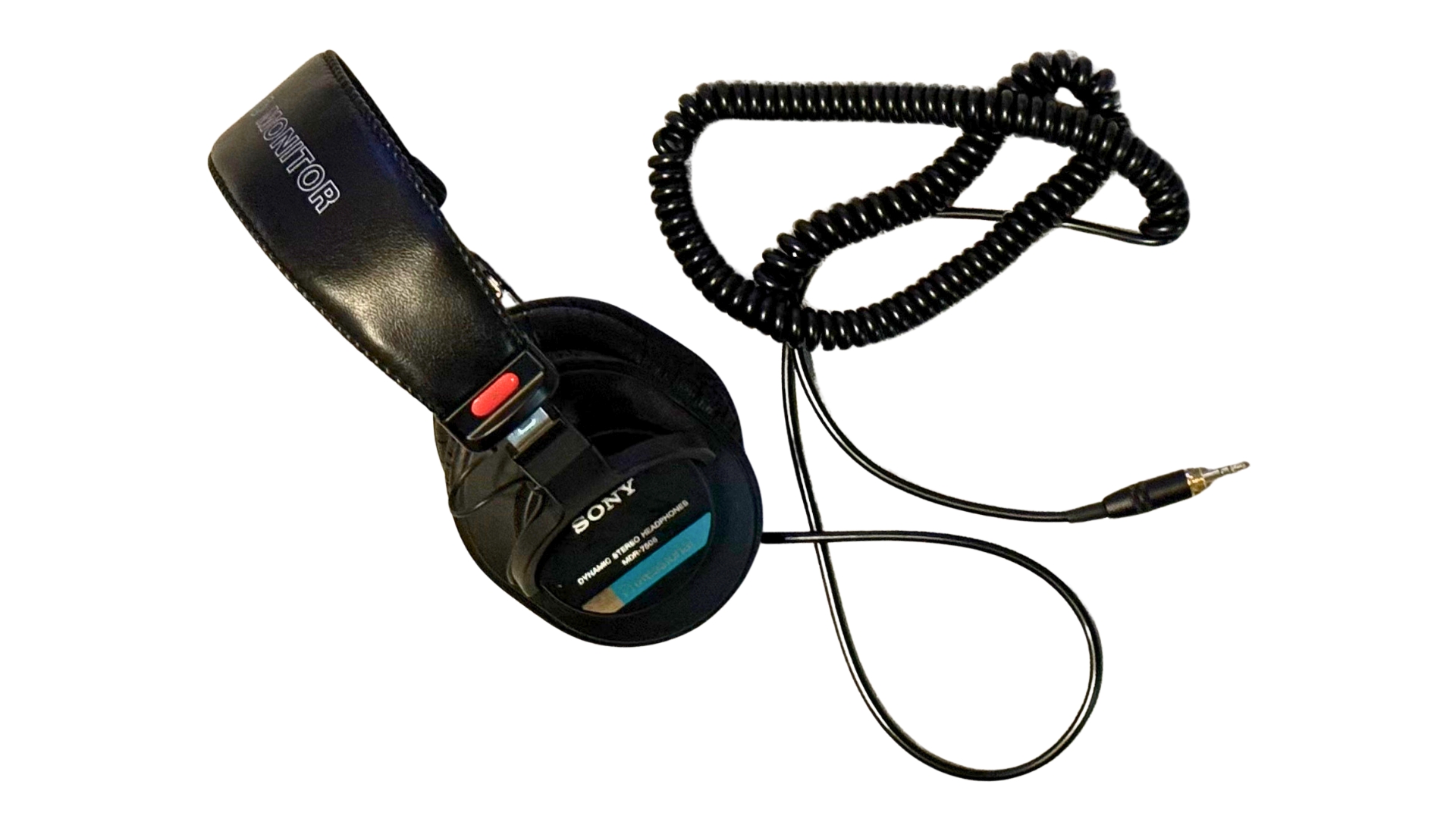
Walk into a tracking room, a news truck, a film set, a podcast closet, or a college radio station and you will find the same pair of headphones: black plastic, blue-and-silver badge, a coiled cable that never seems to end. The Sony MDR-7506 (opens in a new tab) is not the best-sounding headphone anyone owns. It is the one everyone owns.
Where it came from
The story starts in 1985 with the Sony MDR-V6, a closed-back consumer monitor headphone with 40mm drivers that professionals quietly adopted because it was accurate, cheap, and hard to break. Sony noticed. In 1991 the company shipped the MDR-7506 through its Professional division, the same catalog that sold broadcast decks and field recorders to networks. Same basic design, neodymium magnets, a gold-plated 3.5mm plug with a screw-on quarter-inch adapter, and a coiled cord built for someone standing at a console, not sitting on a couch.
That distribution choice is most of the reason it took over. The 7506 did not have to win over listeners. It arrived on the same purchase orders as the cameras and mixers, in the pouch, with a spec sheet, priced under a hundred dollars. Facilities bought them ten at a time.
Why it became the standard
Four things kept it in the racks for thirty-five years.
Predictability. The frequency response is bright and midrange-forward with a lift in the presence region. That is not flattering, and it is the point. Sibilance, mouth noise, hum, a bad edit, a hi-hat that is 3 dB too hot — the 7506 shoves all of it forward. Engineers do not use them because things sound good on them. They use them because problems sound bad on them.
Isolation. Closed-back with a firm clamp means low bleed into a vocal mic and enough attenuation to hear a boom track next to a running generator.
Repairability. Earpads, headband pads, and drivers are all available, and swapping pads is a five-minute job. The famous flaking pleather on old pairs is a $12 fix, not a replacement.
A shared reference. This is the underrated part. When a mixer in Los Angeles and a location recordist in Atlanta both know what a track sounds like on 7506s, they are speaking the same language. Standards spread because they save conversations.
Check the current price on the MDR-7506 (opens in a new tab)
Who actually uses them
Rather than repeat internet rumors about specific producers'' rigs, look at where they verifiably live. Sony sells the 7506 as broadcast and post-production hardware, and it shows up as issued kit at television networks, in ENG and field-recording bags, in ADR and Foley suites, and in the tracking rooms of nearly every commercial studio that keeps spare cans for musicians. Wirecutter has recommended it for years on the strength of exactly that ubiquity, and reviewers covering film and video work describe it as the baseline every other headphone gets measured against.
You have also seen them without noticing. Production designers put 7506s on desks in studio scenes because they read instantly as "professional audio." Camera operators wear them around their necks in behind-the-scenes footage. The headphone became visual shorthand for the job.
The honest version of "who uses them" is this: the 7506 is rarely anyone''s favorite headphone, and it is very often the second pair in the room — the reference check, the loaner for the singer, the pair in the gig bag. That is a more durable kind of fame than a celebrity endorsement.
What they are not
They are not a mixing endgame. The treble lift will trick you into dulling your highs, and the bass is tight but shallow down low, so low-end decisions need speakers or a second reference. The coiled cable is heavy and not detachable without a mod. If you wear glasses, the clamp gets old after a couple of hours. And imaging is narrow compared with open-back headphones at the same price.
Use them for what they are good at: tracking, editing, noise-hunting, checking mono, and field work where isolation matters more than soundstage.
How to get the most out of a pair
- Swap the stock pads for velour or thicker replacements if the clamp bothers you; expect a small loss in high-end bite.
- Learn them on records you know cold before you trust them for a mix decision.
- Use them as the "is this clean?" pass, then confirm tone on monitors.
- Keep the quarter-inch adapter screwed on in the studio and in a pocket on location, because it will walk off.
- If the pads flake, replace them. A twenty-year-old 7506 with fresh pads performs like a new one.
Worth it in 2026?
Nothing has replaced it, which is the whole argument. Cheaper headphones exist and mostly sound like it. Better headphones exist and cost three times as much. For a first serious pair, a spare for the vocal booth, or a set you will throw in a bag and abuse, the MDR-7506 (opens in a new tab) is still the safest hundred dollars in audio.
Sampled is an Amazon Associate and may earn from qualifying purchases made through links in this article.