 SAMPLED
How Do You Tune Electronic Productions to A=432 Hz Without Wrecking Your Samples?
A practical session guide to setting A4 at 432 Hz, retuning 440 Hz sample libraries and avoiding pitch-shift artefacts, with no healing claims.
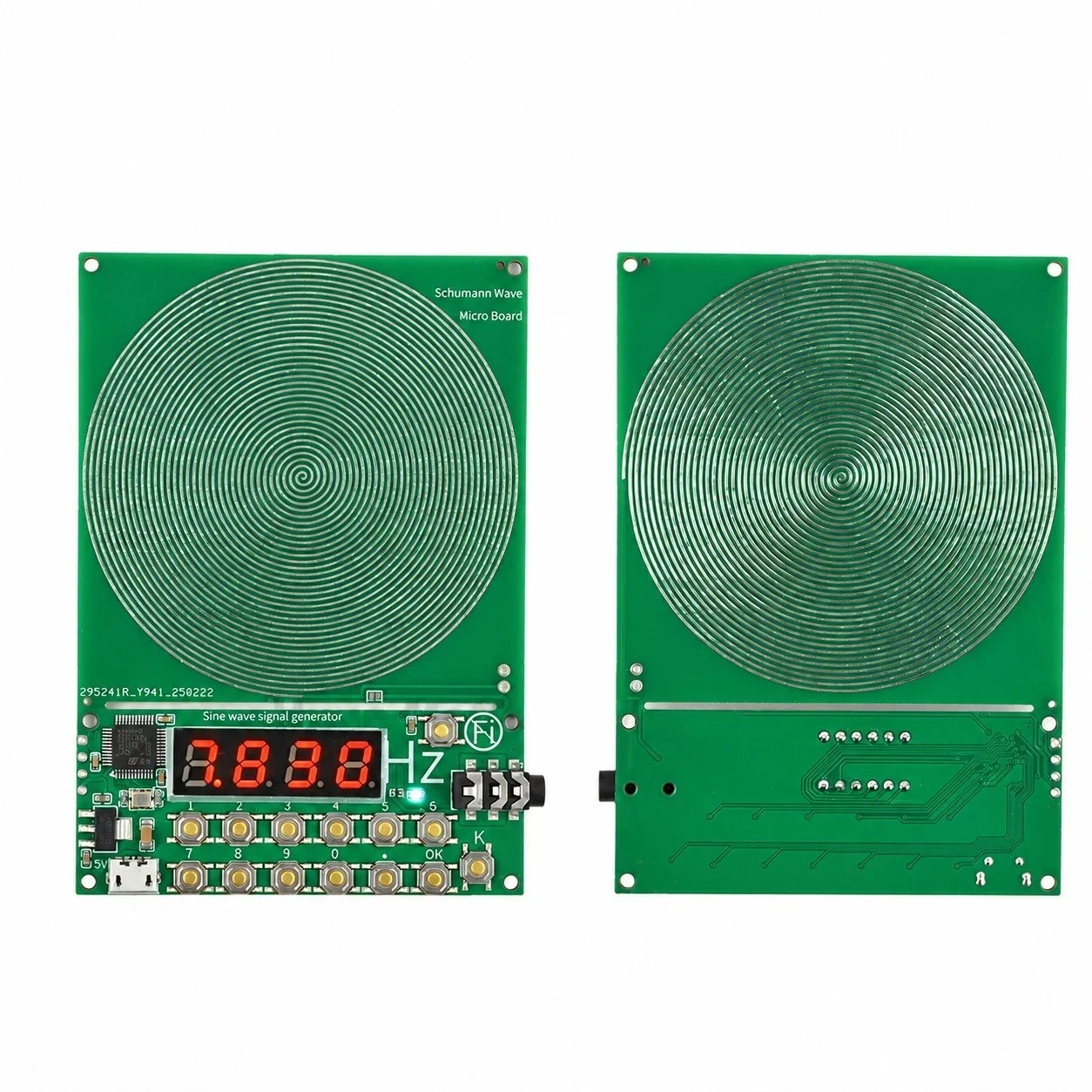
By Tom Giraud. Edited by Sampled. Tom is an independent maker and producer in Mouriès, France, and he builds the programmable sine generator shown in this article. He wrote this guest piece for Sampled; it is not an independent review.
A lot of internet folklore treats A=432 Hz as a moral choice. For electronic producers, it is a session-tuning decision with technical consequences: how you set A4, how you retune sample libraries recorded at 440 Hz, and how you keep a drum bus from turning into a smear of pitch-shift artefacts. This article stays in the control room. It does not argue that 432 Hz heals anyone, and a tone generator is not a medical device.
First, the standard you are departing from
The international reference for concert pitch is A4 = 440 Hz, fixed in ISO 16 (first published in 1955, revised in 1975). That figure did not appear out of nowhere. The American Standards Association adopted 440 Hz in 1936, an international conference in London recommended it in 1939, and the BBC was already using a 440 Hz reference. Earlier, in 1859, a French commission proposed a diapason normal of 435 Hz after decades of pitch inflation in European orchestras.
The pitch of A has wandered widely by city and century, a story documented in Bruce Haynes's A History of Performing Pitch (Scarecrow Press, 2002). So choosing 432 Hz today is not a return to one ancient standard. It is one more working pitch. Giuseppe Verdi's late-19th-century preference for 432 Hz, often cited as "Verdi tuning," is a genuine composer's opinion. It is not a law of acoustics, and it does not make 440 Hz a conspiracy. Stories that blame a political plot for 440 Hz sit poorly next to the American and British timeline.
In equal temperament, 432 Hz is about 32 cents below 440 Hz, a little under a third of a semitone. Some listeners hear a slightly darker colour; others hear a transposition and nothing more. Both reactions are reasonable. Neither is a clinical finding.
What breaks when you "just pitch the master"?
Dropping a finished stereo bounce by 32 cents is the fast way, and the messy one.
- Transient-rich material. Kick, snare, hats and percussion suffer first. Time-preserving pitch algorithms keep the grid but smear cymbals and the front of a snare. Tape-style pitch changes (no time preservation) also change the groove. Listen on headphones before you commit.
- Vocals recorded at 440 Hz. A retuned instrumental under an untouched vocal is obvious immediately. Pick one A4 for the whole project, including stacked a cappellas and ad-libs.
- Sampled instruments. Many piano, string and brass libraries were performed at 440 Hz. If the plugin has a master-tune or A4 parameter, use it instead of pitching the printed output. Not every instrument offers one, and some stretch unpleasantly when asked to move.
- Tuned percussion and 808s. A bass drum written to a 440 Hz tonic will sit slightly differently against a 432 Hz bassline. Recheck the relationship; the same MIDI note may not play the same harmonic role once the reference moves.
- Collaborators and stems. Write "A4=432" in the session notes and on the stem list. A guest guitarist who tunes with a phone app left at 440 Hz will be almost a third of a semitone sharp.
The cleanest path is usually to set the session and every virtual instrument's A4 to 432 Hz before you record or print, then retune only the libraries that need it, one device at a time.
How do you get a reference tone you can trust?
You need a stable A4 = 432.00 Hz, ideally a sine wave, so a tuner sees one spectral line and your ear isn't distracted by bright harmonics. A software oscillator in your DAW can do this if the project sample rate is correct and no hidden pitch macro is engaged. A hardware sine source has one practical advantage: it sits outside the session, so you can't accidentally tune a piano to a track that was already shifted.
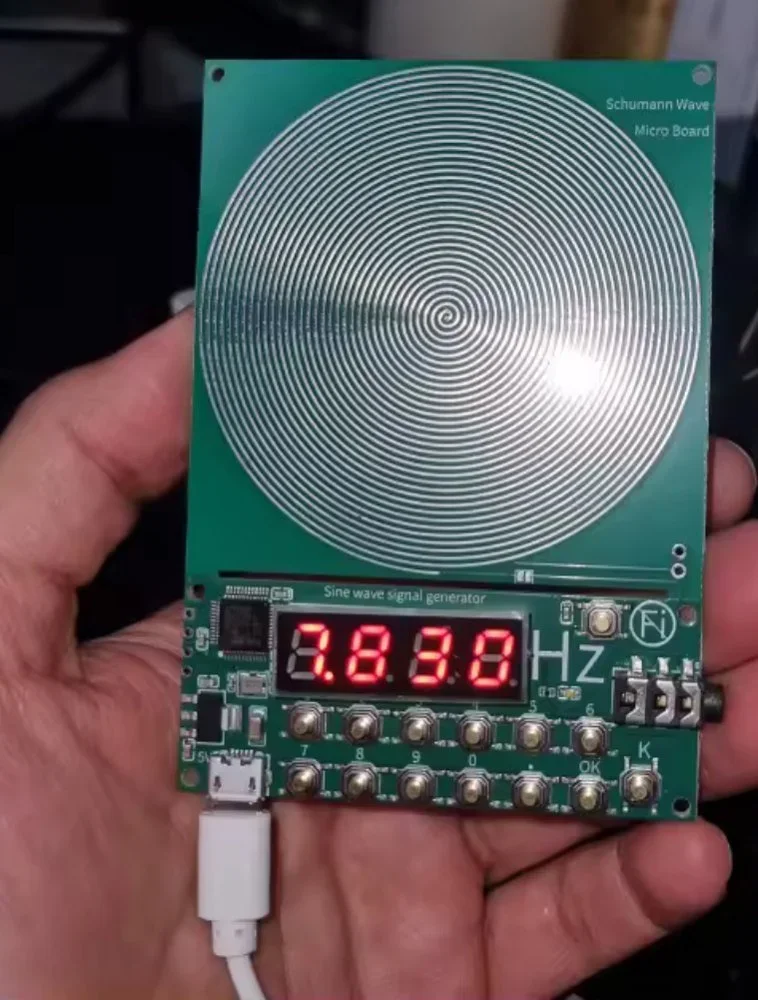 The author's programmable USB sine generator. Photo: Tom Giraud / LA FORGE DIGITAL
A small USB programmable frequency generator is enough: type 432, confirm, and feed the 3.5 mm output into a monitor or wired headphones at low level. These boards often cover 0.01 Hz to 100 kHz, far more than you need for pitch, but the same jack is handy later for a 1 kHz or 10 kHz line-up tone. It is a reference and a test tool, not a wellness appliance.
A short alignment routine
- Set the tuner, and the DAW or synth master tune where it exists, to A4 = 432 Hz. Don't eyeball "-32 cents."
- Play the sine into the monitors, quietly.
- Adjust the instrument until the beating between the sine and the note slows and stops.
- Check a high E and a low A, not only A4, especially on acoustic or electric pianos.
- Label the project and the export.
If a bounce still measures 440 Hz, the transposition was applied to the wrong bus. It happens more often than the folklore admits.
Software oscillator or hardware sine?
A stock synth oscillator is convenient and, in a well-set session, accurate. It becomes untrustworthy when there is a global pitch bend, a detune on a "warmth" preset, or a project converted carelessly between sample rates. A dedicated sine generator does one job and keeps that job out of the arrangement. Use software for speed, and hardware when you want an independent referee, or when you are also checking a room tuner, a hardware synth or a guitar.
Neither tool will "convert" a track into a more natural universe. They will only tell you, honestly, where A4 is.
What about 7.83 Hz "Schumann" files?
Sample marketplaces sometimes sell "Schumann 7.83 Hz" beds for electronic projects. The Schumann resonances, described theoretically by W. O. Schumann in 1952, are extremely low-frequency electromagnetic modes of the Earth-ionosphere cavity, with a fundamental near 7.83 Hz. That is not a pitch your monitors will reproduce as a musical note, and it is not a substitute for a 432 Hz tuning reference. If such a loop is audible, it is almost certainly a higher carrier, a pulse or a binaural difference. Worth knowing, so your session notes stay truthful.
About the author
Tom Giraud is an independent maker and producer in Mouriès, in the south of France, and the founder of LA FORGE DIGITAL. He designs programmable USB sine-wave generators (0.01 Hz to 100 kHz) for studio reference, sound practice and audio tests, and describes them as technical tools, not medical devices. Website: sacredfrequencygenerator.com (opens in a new tab).
For more studio reference material, see our music production glossary.