 SAMPLED
Free music licensing courses and resources that actually exist
University courses you can audit for nothing, free micro-courses from the organisation that pays your streaming mechanicals, and government video series — every resource here is real, free to access, and linked.
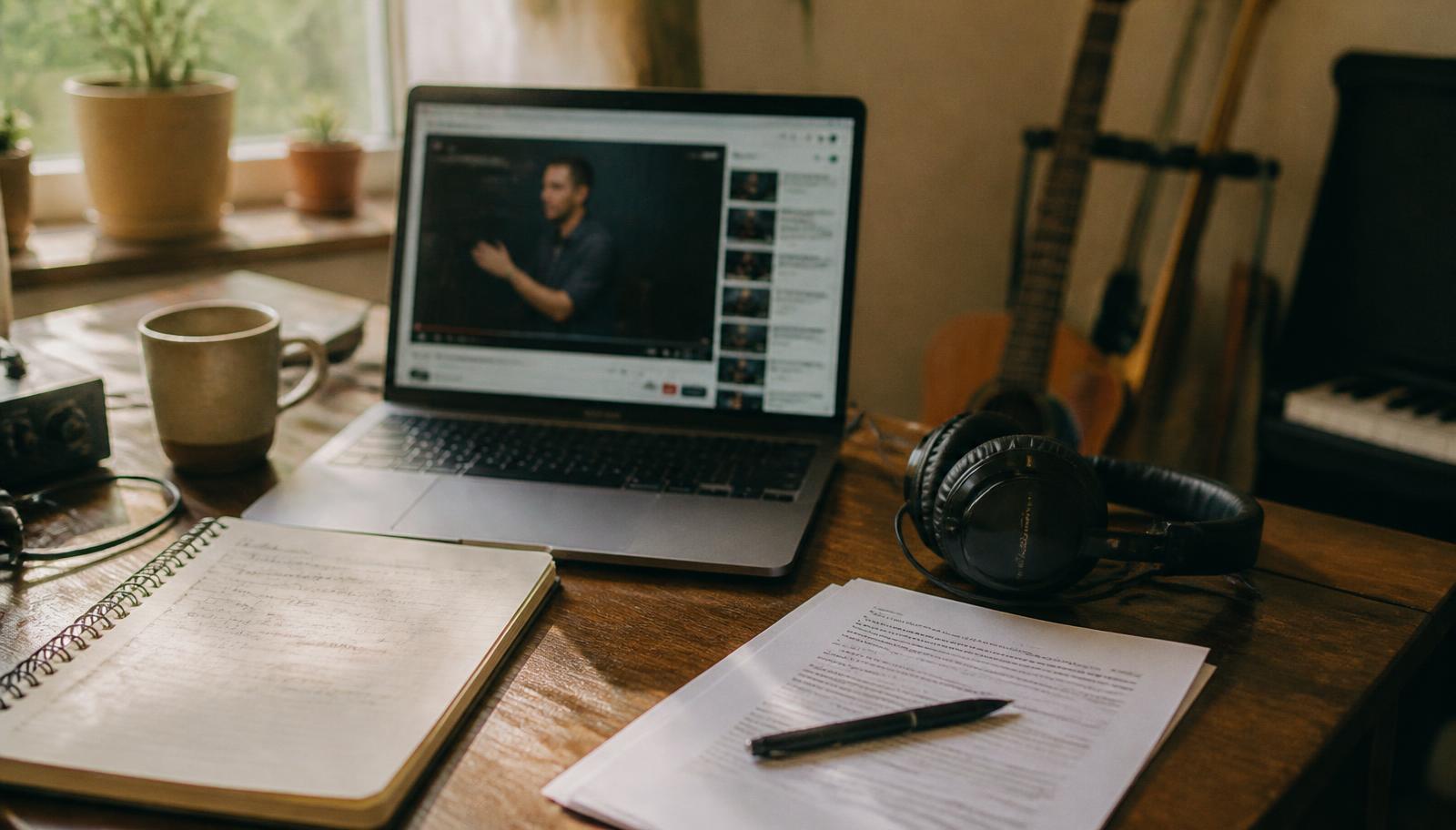
Licensing is the part of the job nobody teaches you and everybody assumes you already know. It is also, unusually, one of the few areas of the music business where the best educational material is free — because the organisations that collect your money have a direct interest in you filling in the forms correctly.
What follows is a list of resources that exist right now, that cost nothing to access, and that are published by the people who actually administer the rights. No affiliate links, no "free trial" that bills you in fourteen days. Where a paid upgrade exists, it is flagged.
University courses you can audit for free
Coursera's audit mode gives you the video lectures and readings for nothing. You pay only if you want the graded assignments and a certificate. For licensing, four are worth the time:
- Copyright Law in the Music Business (opens in a new tab) — Berklee College of Music, taught by Dr. E. Michael Harrington, who spends much of his professional life as an expert witness in infringement cases. Four modules, beginner level, and the single best free starting point if you do not know what a compulsory licence is. Nearly 20,000 enrolments and a 98% satisfaction rate.
- How to Make Money with Your Music Copyrights (opens in a new tab) — also Berklee, taught by Professor Tonya Butler, J.D., LL.M. Four modules, roughly seven hours, and more practical than the title suggests: it is about the revenue streams each copyright generates and who collects them.
- Music Business Foundations (opens in a new tab) — Berklee again, with John P. Kellogg, Esq. Nearly 70,000 people have taken it. It is the wide-angle course; licensing is one chapter of several, but the framing is useful before you go deep.
- Understanding the Music Business: What is Music Worth? (opens in a new tab) — Vanderbilt University, seven modules with Jen Gunderman. This one is about valuation and how money moves through the industry, which is the context that makes licensing rates make sense.
A note on the paid alternative: Berklee Online sells a full Music Licensing (opens in a new tab) undergraduate course. It is genuinely comprehensive and it is genuinely not free. Take the Coursera courses first and see whether you still need it.
Free micro-courses from the MLC
The Mechanical Licensing Collective (opens in a new tab) — the body that administers the blanket mechanical licence in the United States and pays streaming mechanicals to songwriters — runs a set of free online micro-courses. They are short, self-paced, and aimed at exactly the person who has songs on streaming services and no idea whether the money is being matched. Music Registration 101 covers why and how to register your works; if you take one thing from this entire article, take that one.
The MLC also keeps an archive of webinars and videos (opens in a new tab), including recordings of past sessions and short explainers, plus material specifically for students (opens in a new tab) and an educator toolkit (opens in a new tab) for anyone teaching this at college level.
The U.S. Copyright Office, which is better at video than you would expect
The federal government publishes a surprising amount of clear, free, well-produced material:
- Learning Engine video series (opens in a new tab) — short videos introducing copyright concepts, also posted on the Copyright Office YouTube channel. This is the YouTube option, and it is authoritative rather than an influencer's summary of a summary.
- What Musicians Should Know about Copyright (opens in a new tab) — a video and page covering what copyright protects and how registration of works and recordings differs.
- Music Modernization Act educational materials (opens in a new tab) — video and print resources on how statutory licensing changed after 2018, including the plain-English PDF How Songwriters, Composers, and Performers Get Paid (opens in a new tab). Print it and keep it near the desk.
- Licensing documents and circulars (opens in a new tab) — the primary-source layer. Circular 73A on the compulsory licence for phonorecords is dry and definitive.
SoundExchange, for the recording side
Performance royalties for sound recordings on non-interactive digital radio are a separate pipe from anything a PRO collects, and SoundExchange runs free webinars (opens in a new tab) on claiming them, plus a Licensing 101 (opens in a new tab) section written for services that need a statutory licence — useful reading even if you are on the receiving end, because it shows you what the payer sees.
Publishing explainers from administrators
Songtrust's Resource Center (opens in a new tab) is a commercial company's content marketing, and it is also one of the clearest free libraries on publishing administration anywhere. Their Modern Guide to Music Publishing (opens in a new tab) is a free download covering copyright basics through royalty collection. Read it knowing they would like you to sign up; the information is still accurate.
On the performance-rights side, ASCAP's licensing FAQ (opens in a new tab) explains blanket licensing from the licensee's perspective, which is the fastest way to understand why a venue pays what it pays.
International, and free in the strongest sense
- WIPO — How to Make a Living from Music (opens in a new tab) — the World Intellectual Property Organization publishes David Stopps's book in full as a free PDF (opens in a new tab), now in its third edition, released under a Creative Commons Attribution 4.0 licence. That means you can legally redistribute it to your whole group chat. It runs to several hundred pages and covers licensing across territories, which the US-centric material does not.
- The Ivors Academy Knowledge Toolkit (opens in a new tab) — free, UK-focused, written for songwriters and composers: what you own, how you get paid, what to ask before signing.
A suggested order
If you are starting from zero and want a route through this rather than a pile of tabs:
- Watch the Copyright Office's musicians video (opens in a new tab). It fixes the composition-versus-recording confusion permanently.
- Audit Copyright Law in the Music Business (opens in a new tab). This is the backbone.
- Take the MLC's registration micro-course (opens in a new tab) and then actually register your works. Learning without the filing is worthless.
- Register with SoundExchange (opens in a new tab) if you perform on recordings, and watch one of their webinars first.
- Read the WIPO book (opens in a new tab) slowly, over a few weeks, once the vocabulary has settled.
If the vocabulary is the obstacle, our music glossary defines the licensing terms these courses assume you know — sync licence, mechanical royalty, blanket licence, controlled composition clause — with citations to the primary sources, and there is a free certification test at the end of it.
Everything above was checked and reachable at the time of writing. If a link has rotted by the time you read this, the organisation behind it still exists, and their education pages are the place to look.