 SAMPLED
Sampledex built the notes app producers actually needed — and put it on the Mac App Store for free
The team behind the sample store just shipped a focused writing, task, and MIDI-chord workspace for producers. It's free, it's 7.5 MB, and it doesn't touch your data.
Disclosure: The Author owns Sampledex (DBA) and separately owns and operates Sampled. Sampled is a separate business and is not a division, product, or subsidiary of Sampledex or its parent company.
Most "producer productivity" apps are bloated Notion clones that want to run your life. Sampledex (opens in a new tab) — the sample and drum-kit shop behind the Platinum Drum Kit (opens in a new tab) and the ARD x RAP Signature Melody Collection (opens in a new tab) — went the other way. They built Sampledex Producer Notes (opens in a new tab), a single-purpose Mac app for the way producers actually work: capture a lyric in the middle of a session, tag the beat, sketch a chord progression, drag the MIDI into your DAW, keep moving.
It's free on the Mac App Store. It's 7.5 MB. It collects zero data.
What it actually does
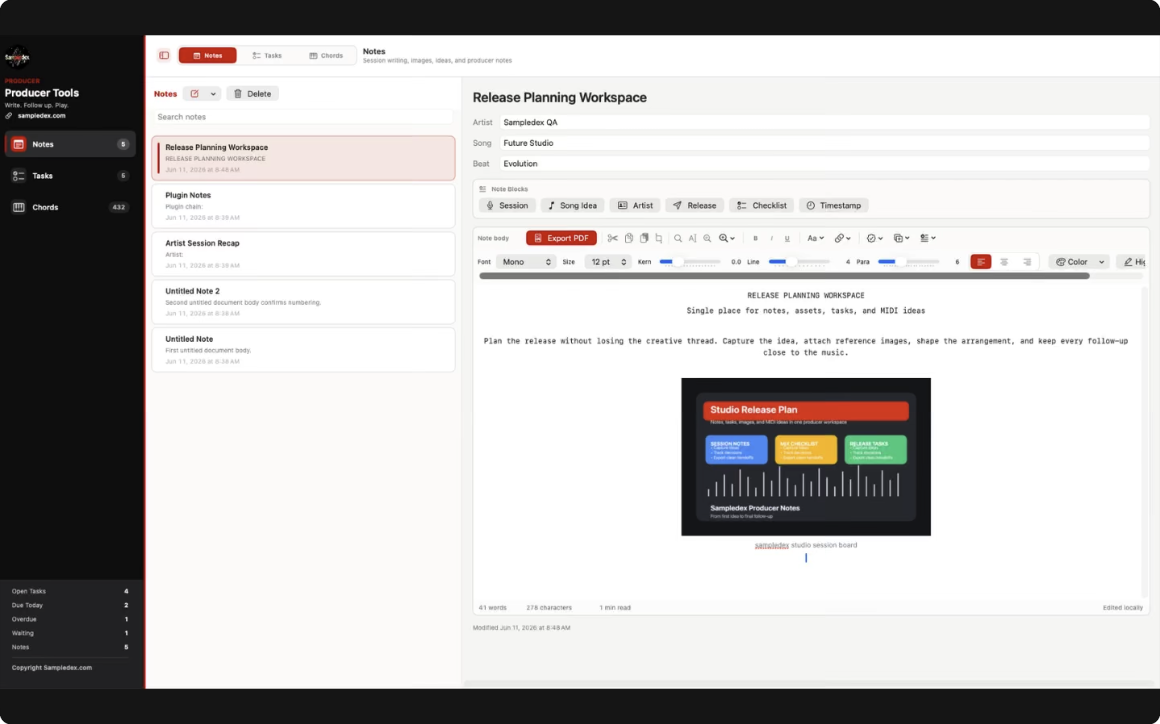
Producer Notes is three tools stitched into one workspace: a rich-text notebook, a task tracker, and a MIDI chord generator.
The notebook is not a plain-text scratchpad. You get headings, links, highlights, colors, tables, checklists, timestamps, and image references — the kind of formatting you need when a "note" is really a session log, a mixdown checklist, or a release plan with links to references. Version 1.0.3 shipped on June 11, 2026 with cleaner rich-text behavior, better PDF export, and steadier undo/redo, according to the App Store version history (opens in a new tab).
The task side turns any note into follow-ups with due dates and status. That's the part indie producers usually lose — the "email the mix engineer," "send the split sheet," "renew the DistroKid subscription" list that lives in seven different places until a release day catches you flat-footed.
The MIDI chord generator is the piece that separates this from a generic notes app. You can preview chords, build a progression in the app, and export the MIDI straight into your DAW. It's built for sketching, not replacing your keyboard — but that's exactly the workflow when an idea hits at 2 a.m. and you don't want to open a full session.
Why Sampledex built it
Sampledex sells sounds. Their catalog (opens in a new tab) runs from ambient trap loop packs like the $9.99 Afterglow Loopkit (opens in a new tab) to full toolkits like the $39.99 City Drop DnB pack (opens in a new tab). Producers who buy sample packs are the same producers drowning in half-finished ideas, folder chaos, and "what BPM was this again" notes. Building the tool their customers actually needed — and giving it away — is the move.
It's also a smart tell about where small music-tech shops are going. Instead of chasing subscription SaaS revenue, they're shipping tight native apps that make the paid product (the sample packs) stickier.
The privacy piece
One line in the App Store listing is worth calling out: Data Not Collected. No analytics dragnet, no email harvesting, no ad SDK. For a workspace that's going to hold your unreleased lyrics, session notes, and release plans, that's the right posture. The full privacy policy (opens in a new tab) confirms it.
Who should download it
If you produce on a Mac (M1 or later, macOS 14+), it's a no-brainer free download. If you're on Windows or iPad, you're out of luck for now — this is Mac-only, and the small file size tells you it's a real native app, not an Electron wrapper.
The honest use case: replace the mess of Apple Notes files, a Trello board you never open, and a text file called chords.txt on your desktop with one thing. That's the pitch, and for a free 7.5 MB download, the risk of trying it is zero.
Your move
Grab Sampledex Producer Notes on the Mac App Store (opens in a new tab) — free, no account, no card. While you're there, browse the Sampledex sample catalog (opens in a new tab) — the sound library that funded the app.