 SAMPLED
The producer is now a studio, an AI operator, a vocal sculptor, and a business — four June 2026 releases that prove it
Mission_Watch puts 'AI-assisted' next to 'frontline trauma' in the lede. Fender ships Studio Pro 8.1 with a Studio Assistant and native Moises. ONHELL builds a single by sculpting Horsey's vocal. Ricki Erik turns a singer-songwriter career into a holding company. Read together, they're a job-description rewrite in real time.
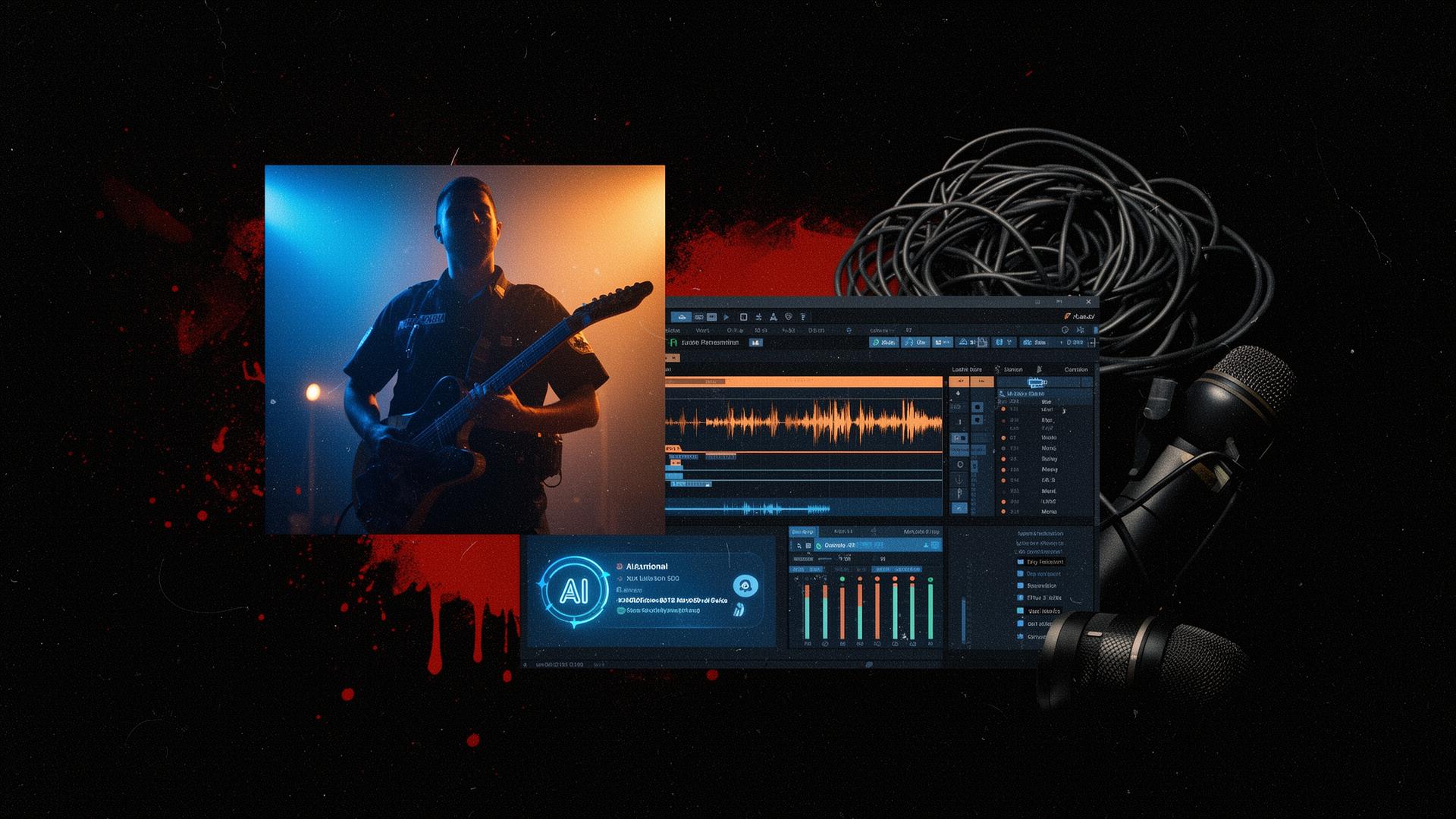
The press cycle this week was unusually honest about one thing: the producer's chair has gotten weirder. A retired paramedic in Pennsylvania is running an AI-assisted cinematic-rock studio out of trauma and recovery. Fender — yes, that Fender — shipped a DAW update that bolts Moises stem-splitting and a "Studio Assistant" into a flagship version called Studio Pro 8.1. An electronic producer named ONHELL (opens in a new tab) put out a single built around manipulating somebody else's vocal until it became a different instrument. And in the small-business corner of the industry, a singer-songwriter-turned-operator named Ricki Erik (opens in a new tab) is quietly turning a wedding-and-luxury-event practice into a vertically integrated music company.
Four separate press releases. One throughline: production is no longer a craft you can describe with a single noun. It's a hybrid of software, service, scoring, and self-mythology, and everybody is making it up in public.
Mission_Watch and the paramedic auteur
The most disarming release of the week came from EIN Presswire on June 8 (opens in a new tab). The headline is a mouthful — "Mission_Watch Blends Frontline Trauma, Human Resilience and AI-Assisted Production in Cinematic Rock Storytelling" — but the project behind it is simple. Mission_Watch is the cinematic studio alias of Shane Strong, a retired paramedic who is using the language of alternative rock and Americana to write about the parts of emergency work most musicians never get near: the call you don't talk about at the kitchen table, the body memory of a bad shift, the long quiet after.
What makes the release land beyond the human story is the production framing. Strong isn't pitching Mission_Watch as a guy-with-a-guitar Bandcamp project. He's pitching it as a studio — cinematic, layered, scored — built with AI-assisted production tools as part of the toolkit. That phrasing is doing a lot of work. Two years ago, "AI-assisted" in a release about a solo artist would have read as a confession; in June 2026 it reads as a credit line.
The Mission_Watch announcement is small in scale, but it captures something the bigger players are now selling outright: the bedroom producer / first responder / dad / part-time-musician archetype now has access to a production stack that used to require a $400-an-hour room and three other people in it. The interesting move isn't that the tools exist. It's that an independent artist is comfortable putting "AI-assisted" in the lede, next to "frontline trauma." A year ago that combination would have been a PR own-goal. Now it reads like a mission statement.
Fender Studio Pro 8.1: the guitar company that wants the whole session
On June 9, PRNewswire carried Fender's announcement (opens in a new tab) of Fender Studio Pro 8.1, the latest version of the DAW the company has been quietly building into a serious tool for songwriters, producers, and composers. The "8.1" framing is meant to read as incremental, but the feature list isn't.
A short translation of what shipped:
| Feature | What it actually does |
|---|---|
| Studio Assistant | An in-DAW assistant — Fender's version of the "AI co-producer" UI everyone is racing to ship |
| Moises Studio integration | Native Moises (opens in a new tab) stem separation, pitch and key tools inside the session |
| Stem separation | Pull vocals, drums, bass, and "other" out of any stereo file without leaving the project |
| Vocal transformation | Re-pitch, re-time, and re-character a lead vocal as a destructive or non-destructive move |
| Native vocal tuning | Tuning lives inside Studio Pro instead of routing out to a third-party plugin |
| Audio-to-Note improvements | Better polyphonic and monophonic audio-to-MIDI for sketching with a guitar or voice |
| Dolby Atmos headphone personalization | Atmos monitoring tuned to the listener's HRTF without a treated room |
| Workflow upgrades | Faster sessions, better routing, fewer trips to the menu |
Read the table sideways and it's clear what Fender is doing. They've stopped trying to be a guitar company that also ships software and started trying to be the default modern songwriting environment for the kind of artist who picks up a guitar, hums a topline, and wants the rest of the record assembled by lunch. Studio Assistant is the co-pilot. Moises is the cleanup crew. Audio-to-Note is the sketchpad. Atmos-on-headphones is the mix room. Vocal tuning and vocal transformation are the booth.
The political subtext is louder than the feature set. Fender is making a brand-level claim — "Keeping Artists at the Core of the Creative Process" — and using it to land an update that automates a lot of the creative process. That's not a contradiction; it's the new pitch. Every DAW vendor in 2026 is being asked the same question by users and lawyers: who is the author when the assistant suggests the bridge? Fender's answer is the artist, every time, and the assistant is just better tape. Whether the courts and the unions agree is a different article (we wrote one yesterday). For now, the product itself is the strongest argument the major-label DAWs have made that the assistant is here to stay and the work is still yours.
ONHELL and the producer as vocal architect
A few hours after Mission_Watch hit the wire, Fresh Music Freaks ran a release (opens in a new tab) for ONHELL's new single "I Love the Way It Feels" featuring Horsey. On the surface, it's a bass-music single with a guest vocalist. Read the release closely and it's a production statement.
ONHELL — a Denver-via-LA electronic producer who's spent the last few years sitting somewhere between heavy bass, melodic wave, and pop songwriting — describes the track as a blend of all three, and openly says he manipulated Horsey's vocals into the final record. That's the line worth reading twice. It's not "Horsey sings the hook." It's "I took Horsey's voice and built an instrument out of it."
That phrasing is the natural next step from the Fender feature list. When vocal transformation is a one-knob move inside the DAW, the producer's role shifts from capturing a vocal performance to sculpting one. The vocalist is still the source, still the personality, still the credited feature — but the texture, pitch envelope, formant, and timing are creative decisions made by the producer, not artifacts of the performance.
The collaboration model under here matters. Horsey gets a feature credit, presumably a writer split, and the kind of cross-audience push that comes from sharing a release with a bass-music headliner. ONHELL gets a topline that's recognizably human and a sound design palette that's recognizably his. The DAW gets to be the connective tissue. Two years ago, a release like this would've been described as "co-produced." In 2026 it reads like the new normal: the producer is the auteur and the vocalist is the voice cast.
Ricki Erik and the producer-as-operator
The fourth release of the cluster came from EIN Presswire on June 8 (opens in a new tab), and at first glance it doesn't look like a production story at all. Ricki Erik — a singer, songwriter, entertainer, and producer — is expanding the international wedding and luxury event side of his business, with bookings rolling out across North America and a stated push into international markets.
The reason it belongs in this roundup is the sentence about Realm Music Group, Erik's company, which the release describes as building across music licensing, artist development, live entertainment, and luxury event experiences. That's the full producer-as-operator stack:
- Music licensing is the back end — the catalog, the placements, the sync income that pays the lights.
- Artist development is the A&R function — finding, signing, and shaping the next acts.
- Live entertainment is the touring and event-booking arm — the cash business that funds the rest.
- Luxury event experiences is the high-margin, white-glove tier that subsidizes everything else.
Set Erik's release next to the other three and the picture sharpens. Mission_Watch is the solo auteur using AI to scale up. Fender is the gear company turning the DAW into a co-producer. ONHELL is the producer turning a vocalist into source material. Erik is the producer turning a career into a small holding company. All four are descriptions of the same job — producer — and none of them would have made sense to each other in 2015.
The job description is unrecognizable
What the wire told us this week, taken as a single document: the producer is now a studio, an AI operator, a vocal sculptor, and a business. Sometimes all four in the same person. The Mission_Watch artist is doing trauma-driven cinematic rock with an AI in the room. Fender is shipping the room. ONHELL is using the room to remix the guest. Ricki Erik is buying the building.
None of these are stories about a tool. They're stories about a job description rewriting itself in real time — and four different press releases in 48 hours suggesting the same answer to the same question: in 2026, the producer is whoever is willing to do all of it.