 SAMPLED
The AI music reckoning hits a new phase: a session-musicians' union sues the majors, France weighs flipping the burden of proof, and the unsealing of Suno and Udio's "training number"
The American Federation of Musicians is suing UMG and Warner over their Suno and Udio settlements. A federal judge has unsealed Udio's training data. 227 rights organizations are pressing France to legally presume AI firms trained on their work. And Deezer says 70% of "unofficial" 2026 World Cup anthems on its platform are AI. The fight over generative music just got a lot more concrete.
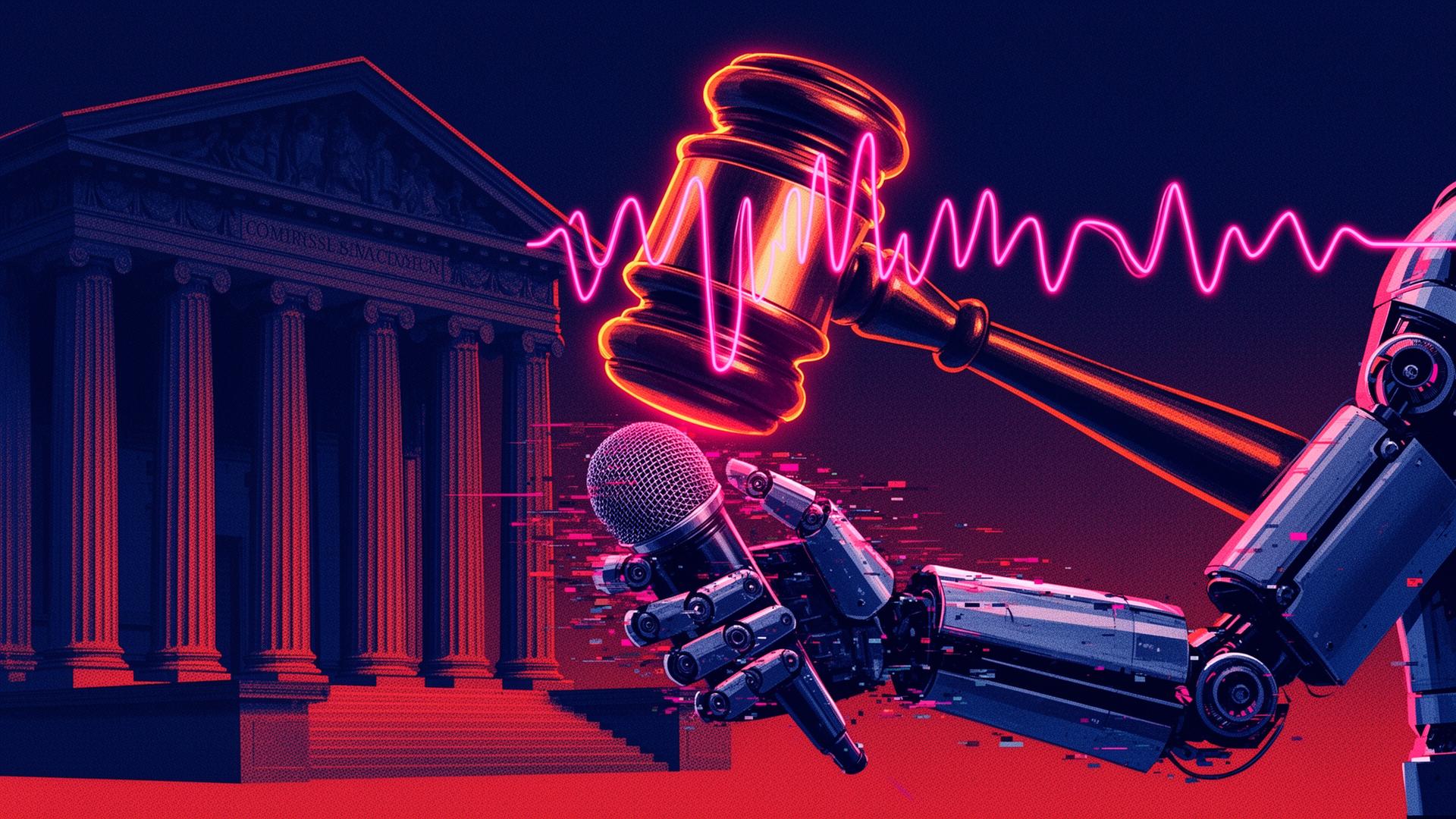
For about two years the story of generative AI in music was mostly about announcements: Suno and Udio raising rounds, the majors filing copyright suits in Boston and the Southern District of New York, the occasional viral fake-Drake. This week the story stopped being about announcements and started being about discovery, dollars and disclosure. Four pieces fell into place between Friday and Monday, and together they describe a market that is finally being forced to show its work.
A union sues the majors over the AI settlement upside
On Friday (June 5), the American Federation of Musicians (opens in a new tab) — the union that represents the session players who actually perform on most major-label records — sued Universal Music Group (opens in a new tab) and Warner Music Group (opens in a new tab) in federal court, alleging the labels breached their collective bargaining agreement when they cut licensing settlements with Suno (opens in a new tab) and Udio (opens in a new tab) without sharing the proceeds with their members.
The complaint, first reported by The Hollywood Reporter (opens in a new tab) and covered in detail by Billboard (opens in a new tab), Music Business Worldwide (opens in a new tab), Digital Music News (opens in a new tab) and Pitchfork (opens in a new tab), argues that AFM members' recordings have effectively been "licensed to Suno and Udio without compensation or credit," and that the union's contracts require the labels to negotiate over new uses of those performances and to share any new revenue.
The argument matters for two reasons. The first is structural: session players are almost never on the back end of a master recording. Their pay comes from union scale plus negotiated special-payments funds that kick in when a recording is reused — for a film, an ad, or, increasingly, an AI training set. The second is precedential. UMG and WMG haven't published the terms of their Suno and Udio settlements, but the size of those deals — and the fact that they appear to include forward equity in the AI companies, not just a one-time check — is exactly what makes a "fair-share" claim plausible to a court. If the AFM wins or settles favorably, expect SAG-AFTRA, the AFM's sister union for vocalists, and overseas neighboring-rights bodies to file the same theory the same week.
The labels declined to comment beyond noting they will defend the suits. The union is asking for damages, an accounting, and an injunction requiring future AI deals to be bargained.
A federal judge unseals Udio's "training number"
While the AFM was filing in one court, Judge Alvin K. Hellerstein (opens in a new tab) was issuing an order in another. On Wednesday, June 3, Hellerstein vacated an earlier ruling that had let Udio keep portions of Sony Music (opens in a new tab)'s copyright complaint against it under seal — including, crucially, the total number of recordings Udio ingested to train its model. Music Business Worldwide (opens in a new tab) and Digital Music News (opens in a new tab) both flagged the order, which followed Udio's own motion last week to keep that figure private on "competitive harm" grounds.
A parallel fight is playing out in Boston in the Suno case. Suno asked the U.S. District Court on May 29 to impound a single number (opens in a new tab) — the total audio-file count UMG and Sony allege it copied. On Monday (June 8), Universal and Sony filed a joint opposition (opens in a new tab) arguing the public is entitled to see it because the figure "speaks directly to the nature and extent of Suno's copying." Complete Music Update (opens in a new tab) put the stakes plainly: this is the number that turns "we trained on lots of music" from a vibe into a count a jury can multiply by a statutory-damages figure.
If one or both of those numbers becomes public in the coming weeks, it will be the first time the AI-music industry has had a fixed, court-stamped figure attached to it. Every existing settlement — and every term sheet currently in negotiation — will be re-priced against it overnight.
227 rights organizations push France to flip the burden of proof
The third piece dropped Monday morning in Paris. A coalition of 227 collecting societies and rights organizations — coordinated by CISAC (opens in a new tab), the international confederation of authors' societies — published an open letter urging France's National Assembly to take up a bill that would establish a legal presumption that generative-AI companies trained on copyrighted works. Music Business Worldwide has the full coalition list and the text of the letter (opens in a new tab).
The bill — known by the name of its Senate sponsor, Laure Darcos, and now in the National Assembly's legislative dossier (opens in a new tab) — would put the evidentiary burden on AI providers to prove their training corpora didn't include protected material. As Actu IA reported (opens in a new tab), the bill was effectively shelved in May; this week's letter is a coordinated push to force it back onto the calendar before summer recess.
The U.S. story this week is a private-law story about contracts and damages. The French story is a public-law story about the default rule. Together they describe a pincer: in America, the discovery process is forcing the AI companies to reveal what they used; in Europe, the legislative process is moving toward a regime where they have to prove they didn't.
The two music-publishing trade bodies most likely to be invoked on the U.S. side — the NMPA (opens in a new tab) and the MLC (opens in a new tab) — have been quiet on the AFM case but supportive of the French effort. Watch SoundExchange (opens in a new tab), IFPI (opens in a new tab) and RIAA (opens in a new tab) for the next round of public statements; they are the ones that historically translate this kind of cross-border momentum into U.S. legislative asks.
And meanwhile, the use case the lawyers are fighting over is already trending
On the same Monday the lawyers were filing, Deezer's newsroom (opens in a new tab) put out a stat that doubles as a thesis. Of the "unofficial" fan-made anthems uploaded to its platform for the 2026 FIFA World Cup — songs about the French, Argentine, Portuguese and Moroccan squads, mostly — 70% are AI-generated. Several have racked up millions of streams. SBS News (opens in a new tab) and Al Jazeera (opens in a new tab) had already noticed the trend before kickoff; Deezer is the first DSP to put a number on it.
It is also the only DSP that has built and shipped a public-facing AI-detection system. Back in April, Deezer disclosed (opens in a new tab) that AI-generated tracks now account for 44% of all new uploads to the platform — nearly 75,000 a day — and that it is excluding undeclared AI tracks from algorithmic and editorial playlists, and stripping their pro-rata share from the royalty pool. The detection backbone is built with Pex (opens in a new tab) and similar fingerprinting tech; fraud-pattern work is being done with Beatdapp (opens in a new tab); the metadata layer is increasingly being handled by tools like Cyanite (opens in a new tab) and AudioShake (opens in a new tab).
Put the four stories on the same desk and the shape of the next 12 months is hard to miss:
- The performers (AFM, then SAG-AFTRA, then international equivalents) are coming for a share of any AI settlement money the labels collect.
- The publishers and societies (CISAC, NMPA, MLC, SACEM) are pushing for a legal regime in which AI companies have to prove their innocence on training data, not the other way around.
- The courts are about to make the actual size of the AI companies' training corpora public, which will make settlement math concrete and statutory damages calculable.
- The DSPs — at least Deezer, so far — are quietly building the detection and pay-out infrastructure that any of the above will need to enforce.
The first generative-music boom was sold as a creator-tools story. What's emerging this week is the back end of that story: who paid, who got paid, and who decides. The numbers attached to all three are about to stop being theoretical.