 SAMPLED
Rio Leyva tried to turn Suno into a sample pack — here is what actually worked
A two-hour livestream where the placement producer runs Suno prompts, chops the results, feeds his own loops back in, and argues in real time with a chat about whether any of this counts as making music.
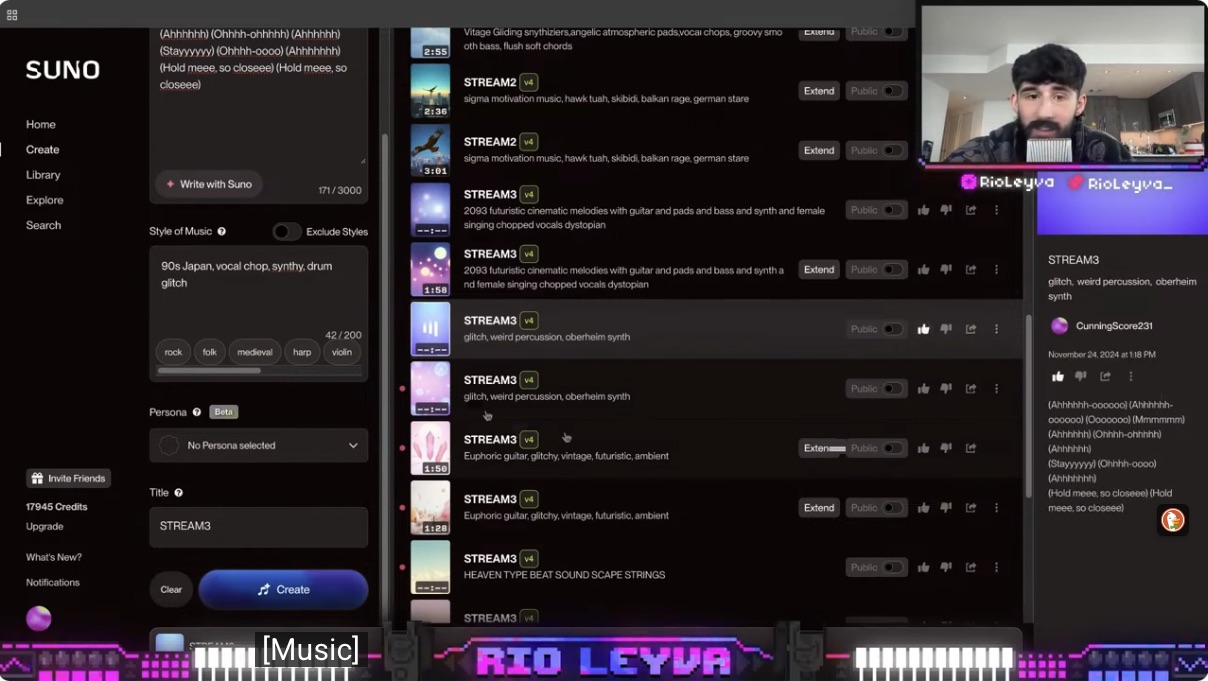
Rio Leyva — placement producer and part of the Internet Money collective — spent a recent livestream doing something a lot of producers are quietly experimenting with and not many are streaming: opening Suno, generating dozens of AI clips, and trying to chop them into something worth putting on a beat. No course, no plugin sponsor, no "buy my method." Just a producer, a DAW, a chat arguing with him about ethics, and a website that was, in his words, "down right now, I got you."
It is worth watching in full if you want an honest look at where generative audio is for a working beatmaker in 2026. Here is what the stream actually surfaced.
The starting premise
Rio's opening pitch was blunt: Suno is "a little bit evil," he suspects it was trained on YouTube, some of the voices sound uncomfortably close to things he has already heard. He is also going to use it, because the outputs are fun to sample and he has "mad credits." That contradiction runs through the entire stream and, honestly, through most working producers' relationship with these tools right now.
The method he sets out to test:
- Write detailed Suno prompts — style, texture, era, mood, instrumentation.
- Generate in bulk, thumbs-down the obvious garbage, download anything with a usable moment.
- Chop those clips like any other sample and build a beat around them.
- Later in the stream, flip the workflow — make his own loop first, then feed it into Suno's extend function to see what the model adds on top.
What actually turned out to be the technique
The first half of the stream is Rio running raw prompts. Most of it, by his own admission, "sucks." He keeps asking chat for "in-depth prompts, complex stuff" and slowly narrows in on the vocabulary that gets Suno to produce chop-able material rather than finished-sounding songs: things like "chopped sample, euphoric female vocals with vocoder, distinct sample chops, tape machine, vintage bells glitching."
The takeaway he lands on partway through is the real lesson of the stream, and he says it plainly:
"Suno doesn't really want to make good music, but you could trick it into making good music."
He then discovers the actual workflow that works for him — and it is not "prompt the model." It is:
- Build a small starter loop yourself. A few chords, a texture, a melodic idea.
- Upload it and use Suno's extend function to have the model continue it.
- Chop the extended output for the moments the AI added — a vocal phrase, a countermelody, a breakdown — that you would not have written.
- Bring those back into the DAW, arrange, add drums, treat the whole thing like any other sample flip.
By the end of the stream he has one loop and one beat he is genuinely happy with, and both of them came from the "run my own idea through it" path, not the "prompt from scratch" path.
The ethics argument, live in chat
Around the halfway point the chat turns on him. Rio does not dodge it — he argues back, in real time, for about ten minutes. His actual position, stripped of the stream-of-consciousness delivery, is worth writing down because it is more honest than most public takes:
- Prompting is not the same as writing a piece of music, and he is not claiming it is.
- Beatmaking has always been built on sampling — from the SP-1200 forward — so "you didn't play every note" is not a new objection.
- The bigger structural problem in beats is not AI. It is that there are already infinite producers chasing a finite number of placements, and plenty of A&R-only "producers" who never made a beat in their life. AI does not create that problem, it exposes it.
- He does not have any released songs built on AI-generated material and is not telling anyone else they should.
He also says, on the training-data question, "what if they used my loop to train the AI" — and leaves it there, unresolved. That is roughly where the honest answer sits right now.
What a producer can actually take from the stream
Whether or not you ever open Suno, the useful lessons from watching Rio work through this are not really about AI at all:
- Bulk generate, then curate ruthlessly. He downloads maybe five clips out of dozens. That is the same ratio serious diggers use with a crate of records.
- Prompt like you would describe a sample to another producer. Vague prompts get vague outputs. Specific era, specific texture, specific instruments, specific mood — same as sending a reference to a session.
- Feed your own material into any generative tool, not the other way around. The strongest results in the stream came from Rio's loops being extended, not from cold prompts. Whatever tool you are using, your starting material is what makes the output sound like you.
- The stem-splitter is the ceiling. Rio keeps hitting it — he wants to pull a bell out of a Suno clip and use only that. Right now the artifacts fight you. He is openly waiting for the "audio repair" side of AI to catch up, which is probably the more consequential thing to watch than the generation side.
Why it is worth watching in full
The stream is unpolished on purpose. Rio talks about his website being broken, cracks all his fingers at once, gets into a debate with chat, and misses his own dislike button. That is the value of it. Most public content about AI in music production is either doom-posting or someone selling you a $497 "AI beatmaker course." This is a working placement producer — one of the Internet Money crew — in a real session, showing exactly how far the tools get him and exactly where they stop being useful.
Watch the stream: Rio Leyva — Suno sampling method (YouTube) (opens in a new tab).
If you want more of Rio's non-AI workflow content, his channel is one of the ones we already flagged in the free YouTube producers actually worth your time in 2026.