 SAMPLED
ASCAP vs BMI vs SESAC: Which PRO Should You Join in 2026?
What a performing rights organization actually pays you, how the three US societies differ now that BMI is for-profit, and how to pick one.
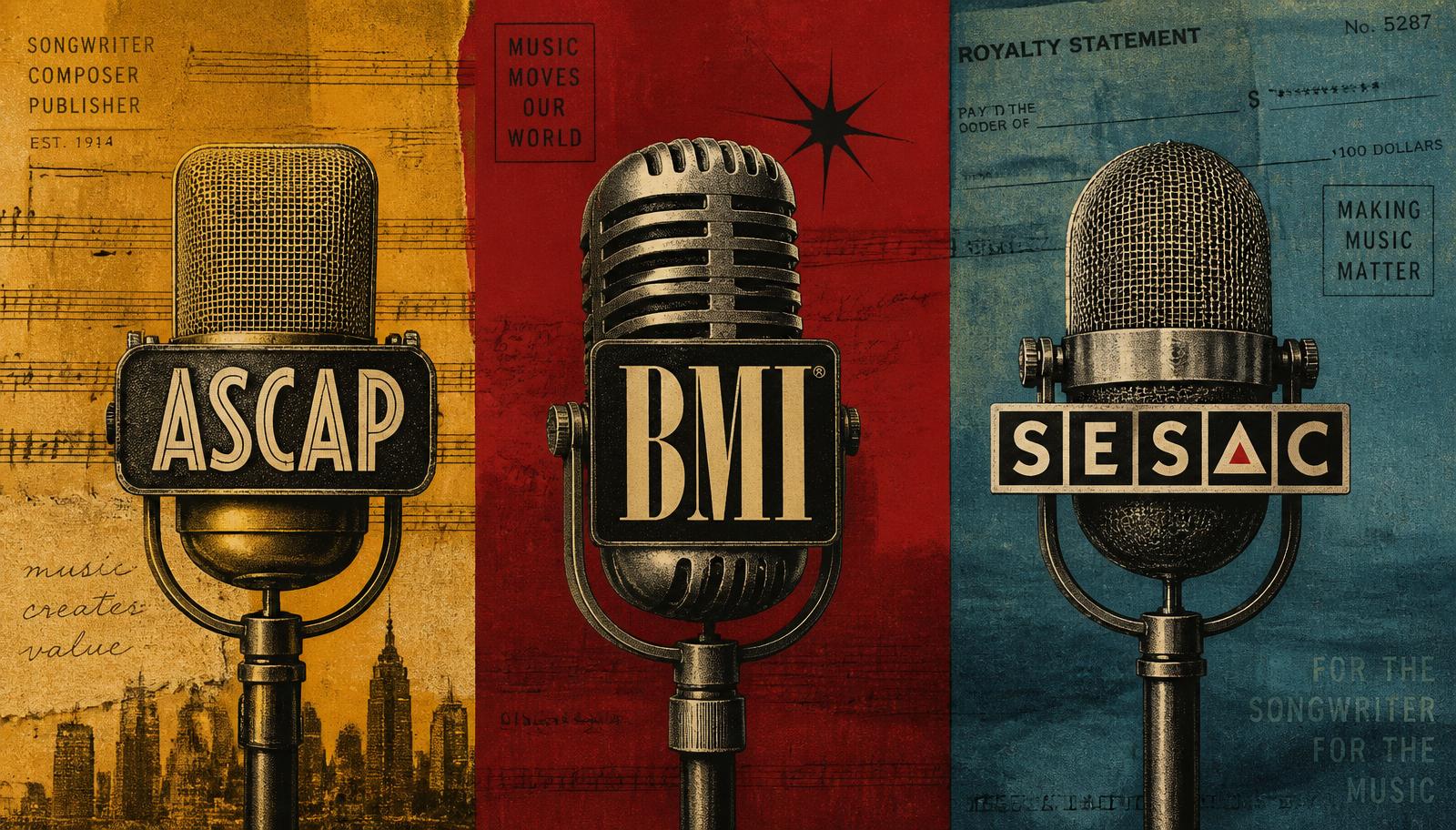
If you write songs and want to get paid when they play — on the radio, in a bar, on TikTok, in a Netflix show — you need a performing rights organization (PRO). In the U.S., there are three that matter: ASCAP, BMI, and SESAC. They all do the same core job: license your compositions to businesses that play music, collect the fees, and pay you public performance royalties.
But they are not interchangeable. One is a nonprofit member-owned collective. One is the biggest by market share and open to everyone. One is invitation-only and quietly writes some of the biggest checks in the business. Picking the wrong one won't ruin your career, but picking the right one can mean faster payouts, more transparent statements, and a better fit for the kind of music you actually make.
Here's the breakdown.
What a PRO actually does
Every time a song is performed publicly — terrestrial radio, satellite radio, streaming, live venues, restaurants, gyms, TV, film — the songwriter and publisher are owed a public performance royalty. That's separate from the recording royalty the label collects, separate from mechanical royalties, and separate from sync fees.
PROs are the only practical way to collect this money. They negotiate blanket licenses with millions of venues and platforms, track performances, and pay out. You cannot realistically do this yourself. Every serious songwriter joins one.
You can only join one PRO at a time as a writer. If you have a co-writer on a different PRO, that's fine — each writer registers their share with their own society. You can also affiliate a separate publishing entity, but the writer half stays with one PRO.
ASCAP: the songwriter-owned nonprofit
Founded in 1914, ASCAP (opens in a new tab) is the oldest PRO in the U.S. and the only one that is a nonprofit, member-governed organization. Its board is elected by songwriters and publishers. Any surplus after operating costs goes back to members as royalties.
Who it fits: Songwriters who want transparency and a democratic structure. ASCAP publishes its distribution rules openly, and its board includes working writers, not just executives. It has strong reach across pop, film/TV, jazz, classical, and Latin music, and its Latin distribution is particularly well regarded.
Cost: A one-time $50 fee to join as a writer. Publisher affiliation is another $50.
Payouts: Quarterly, typically 6–7 months after the performance quarter.
BMI: the biggest tent
BMI (opens in a new tab) was founded in 1939 by radio broadcasters who wanted an alternative to ASCAP. It is a for-profit corporation as of 2024, when it was sold to private equity firm New Mountain Capital in a $1.7 billion deal. BMI has said it will continue paying out the vast majority of collected licensing revenue as royalties, but the shift from its previous nonprofit posture is real, and the songwriter community has been vocal about it.
Who it fits: BMI is the largest PRO by affiliate count — more than 1.4 million songwriters and publishers — and it dominates country, hip-hop, and a big chunk of pop. If you write country in Nashville, BMI is almost the default. It's also the easiest to join and typically the fastest to onboard new writers.
Cost: Free to join as a writer. $150 for a solo publisher, $250 for a publishing company.
Payouts: Quarterly, roughly 5–6 months after the performance quarter — usually the fastest of the three.
SESAC: the invitation-only boutique
SESAC (opens in a new tab) is the smallest and oldest for-profit PRO, founded in 1930. Unlike ASCAP and BMI, you cannot just sign up — SESAC is invitation-only. They approach writers whose catalogs they think they can monetize aggressively.
Because the roster is smaller and hand-picked, SESAC often has more time per writer, negotiates deals directly (it isn't bound by the consent decrees that govern ASCAP and BMI), and can push for higher licensing rates. Historically that has meant strong per-performance payouts for the writers they take on. Bob Dylan, Neil Diamond, and Zach Bryan have all been affiliated.
Who it fits: Writers with an existing track record — chart placements, meaningful streaming numbers, sync placements — whose catalog can justify a bespoke deal. If you're a brand-new writer, SESAC is not on the table yet, and that's fine.
Cost: No fee if you're invited.
Payouts: Quarterly, with a reputation for competitive rates but less public transparency on exactly how the black-box distribution works.
Side by side
| ASCAP | BMI | SESAC | |
|---|---|---|---|
| Structure | Nonprofit, member-owned | For-profit (2024–) | For-profit, private |
| How to join | Open, apply online | Open, apply online | Invitation only |
| Writer fee | $50 one-time | Free | N/A |
| Affiliates | ~990,000 | 1.4M+ | ~35,000 |
| Payout schedule | Quarterly, ~6–7 mo lag | Quarterly, ~5–6 mo lag | Quarterly |
| Strong genres | Pop, film/TV, Latin, jazz | Country, hip-hop, pop | Sync, top-tier pop/country |
| Transparency | High (published rules) | Moderate | Low (opaque distribution) |
How to actually decide
Ignore the "which one pays more?" question. Every long-term study — including a Berklee Institute analysis — has found ASCAP and BMI pay comparably in aggregate. Small per-song differences average out.
The real decision is about fit and friction:
- If you're starting out and want the easiest onramp: BMI. It's free, fast, and the largest catalog in country and hip-hop.
- If you value governance and transparency: ASCAP. You're a member of a nonprofit collective that you can literally vote on.
- If you're already charting or getting sync placements: Wait for SESAC to call, or have your lawyer reach out. Don't chase them cold.
- If you write in Nashville: BMI still dominates country, though ASCAP's country roster has grown considerably.
- If you write for film and TV: Both ASCAP and BMI have deep sync relationships. Pick based on which reps you already know.
Two things every new writer should also do
Joining a PRO is only half the collection puzzle. You also need to:
- Register with The MLC (opens in a new tab) to collect U.S. mechanical streaming royalties. This is separate from your PRO and free. Most new writers leave this money on the table for years.
- Register a publishing entity — even a simple sole-proprietor "self-published" affiliation with your PRO — so you collect the publisher's 50% share of performance royalties instead of ceding it. If you don't, that money sits in your PRO's unallocated pool.
Do those two things the same week you affiliate with a PRO, and you'll be collecting more from your catalog than most independent writers ever do.
Frequently asked questions
Can I join ASCAP, BMI, and SESAC at the same time?
No. You can only affiliate with one U.S. PRO as a writer at a time. If you co-write with someone on a different PRO, that is fine — each writer registers their share with their own society. You can also set up a separate publishing entity, but the writer share stays with one PRO.
Is BMI really free?
Yes — joining BMI as a songwriter is free. Setting up a solo publishing entity costs $150, and a full publishing company costs $250. ASCAP charges a one-time $50 writer fee. SESAC does not charge a fee, but you can only join by invitation.
How much does ASCAP cost?
ASCAP charges a one-time $50 fee to join as a writer. Publisher affiliation is another $50. There are no annual dues.
Can I switch from ASCAP to BMI or BMI to ASCAP?
Yes, but there are rules. Most PROs require a waiting period — often around two years from your last affiliation — and you cannot have active songs registered with multiple PROs under the same writer share. If you are mid-term on a publishing deal, your publisher may also need to approve the move. Plan it carefully with your rep or lawyer.
Which PRO pays the most?
Long-term studies, including analysis from Berklee, show that ASCAP and BMI pay roughly the same in aggregate. SESAC can pay very well for writers it aggressively represents, but it is invitation-only and less transparent. The biggest variable is usually how complete your registrations are, not which PRO you pick.
Which PRO is best for hip-hop, country, pop, or film/TV?
- Hip-hop: BMI has a massive urban roster and fast onboarding.
- Country: BMI still dominates Nashville, though ASCAP's country presence has grown.
- Pop: Both ASCAP and BMI are strong; pick based on community and reps.
- Film/TV: Both ASCAP and BMI have deep sync relationships. SESAC also has a strong sync reputation but is invitation-only.
- Latin: ASCAP has a particularly well-regarded Latin distribution system.
Do I need a publisher account too?
If you are self-published, you should. Without a publishing entity, the publisher's 50% share of your performance royalties sits in your PRO's unallocated pool instead of reaching you. All three PROs let you set up a simple sole-proprietor publishing affiliation.
What is The MLC and do I need it if I already have a PRO?
Yes. The MLC (opens in a new tab) collects U.S. mechanical streaming royalties, which are separate from the public performance royalties your PRO collects. A PRO does not handle mechanicals. The MLC is free to join and many independent writers miss this income entirely.
Do producers and beatmakers need a PRO?
If your beats contain original melodies or songwriting contributions and those compositions get publicly performed — on streaming, radio, TV, or live — you are owed public performance royalties. A PRO is how you collect them. Purely non-melodic drum beats generally do not qualify on their own.
How long until I get my first royalty check?
Expect a lag. Performance royalties are typically paid quarterly, roughly 5–7 months after the performance quarter. That means a radio play in January might not show up in your account until summer. Streaming performances usually take even longer to process.
Does joining a PRO mean I keep all my rights?
Yes. A PRO does not take ownership of your copyrights. You are granting them the right to license and collect public performance royalties on your behalf. You keep the copyright and can still do direct sync deals, mechanical licenses, and other arrangements.
Why is SESAC invitation-only?
SESAC keeps its roster small and curated so it can negotiate directly with licensees and spend more time per writer. It is not bound by the consent decrees that govern ASCAP and BMI, so it can pursue bespoke deals. That model works best for writers who already have momentum.
I am an independent artist with no label. Should I still join a PRO?
Yes. Labels collect recording royalties; PROs collect songwriting royalties. Even if you self-release, if your music is played in public — on Spotify, YouTube, radio, TV, or live venues — your PRO is the practical way to get paid for the composition side.
The bottom line
There is no wrong choice between ASCAP and BMI for a new writer — both work, both pay, both cover the same performances. Pick the one whose values and community fit you better and get on with writing. SESAC will find you if you're the kind of writer they want. What actually matters is that you're registered somewhere, that your publisher share is set up, and that you're also collecting mechanicals from The MLC.
The money is there. It just doesn't collect itself.
What changed recently
BMI is a for-profit company now. Its sale to New Mountain Capital closed on February 8, 2024 (opens in a new tab), ending its long run as a broadcaster-owned nonprofit. The deal was structured to send a $100 million payout to BMI affiliates, and Mike O'Neill stayed on as CEO. BMI's Royalty Policy Manual (opens in a new tab) was last revised in August 2025, so read the current version rather than anything you remember.
ASCAP is still the nonprofit. It distributed roughly $1.76 billion to members in 2025 and remains member-governed, with rules published openly.
GMR changed hands. Global Music Rights, the fourth and smallest invitation-only US PRO, saw its majority stake sell in a deal valuing the company at $3.3 billion (opens in a new tab) at the end of 2024.
SESAC remains invitation-only and continues to operate its awards and licensing business normally.
Membership fees at all three change from time to time. Both ASCAP and BMI currently present songwriter membership on their join pages (ASCAP (opens in a new tab), BMI (opens in a new tab)) — check the fee on the day you sign up rather than trusting any article, including this one.
Do not forget SoundExchange
A PRO collects performance royalties on the composition. SoundExchange collects digital performance royalties on the recording from non-interactive services like satellite and internet radio. It has paid out over $12 billion since 2003, and it is a separate free registration. Artists who join a PRO and stop there leave that money sitting.
Questions people actually ask
What does a PRO actually pay me for? Public performances of your composition: radio, TV, streaming, live venues, bars, gyms, retail. Not record sales, not your distributor's streaming royalties.
Can I join more than one PRO? Not as a writer. One at a time. Co-writers can each be with a different society.
Is BMI or ASCAP better for a new songwriter? Both work. BMI is the biggest tent and typically the fastest to onboard; ASCAP is the nonprofit with published distribution rules. Nashville country leans BMI heavily. It is not a decision worth agonising over.
How do I join SESAC? You do not — SESAC approaches writers. If you are new, this is not a rejection, it is just how they operate.
How long until I get paid? Quarterly, and typically five to seven months after the quarter in which the performance happened. Budget for the lag.
Do I need a publishing administrator too? If you want mechanical and international royalties collected properly, usually yes. Some distributors bundle it — see our DistroKid vs TuneCore comparison.
Is any of this relevant if I only get streams? Yes. Streaming generates a performance royalty on the composition that your distributor does not collect. See our Spotify royalties breakdown.